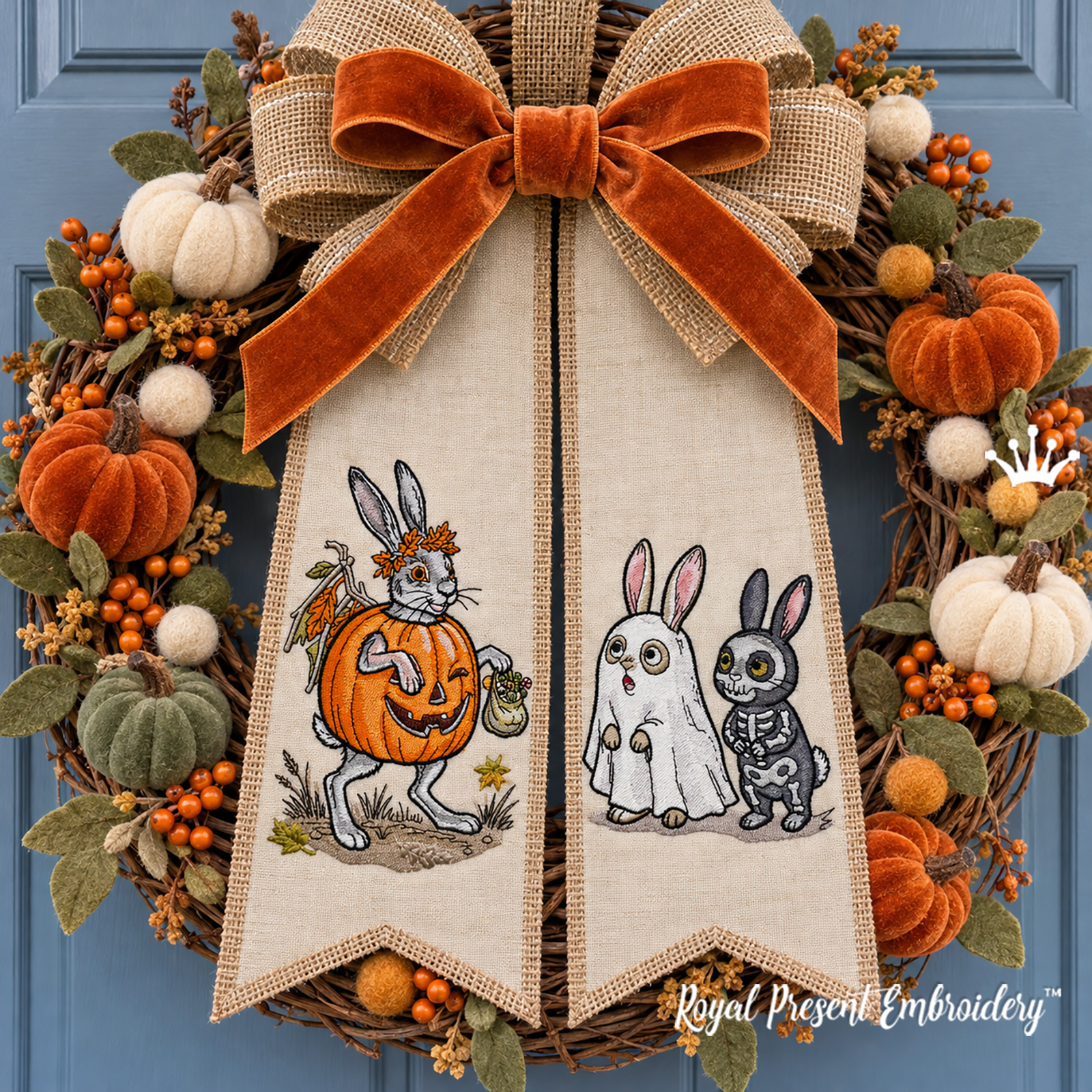
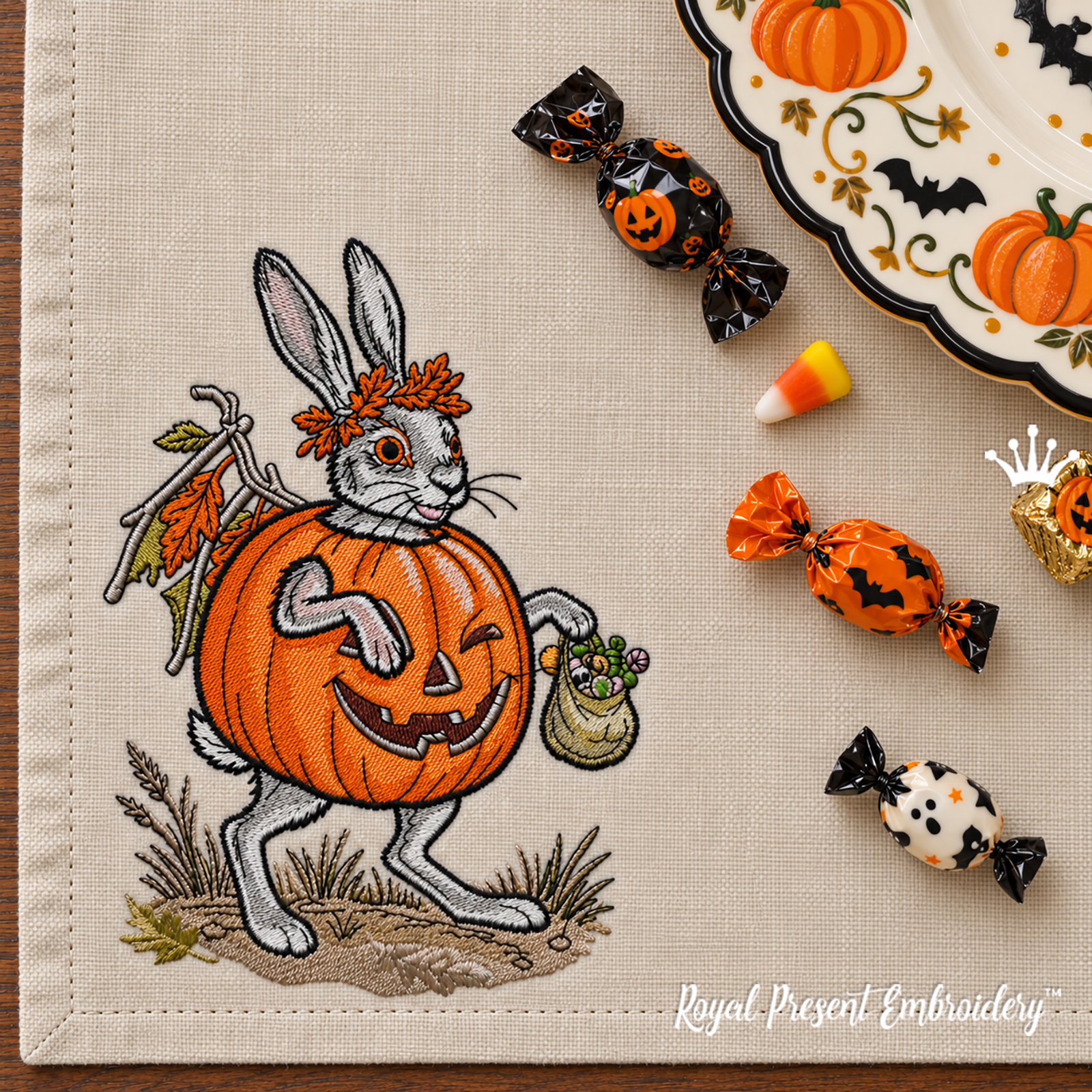
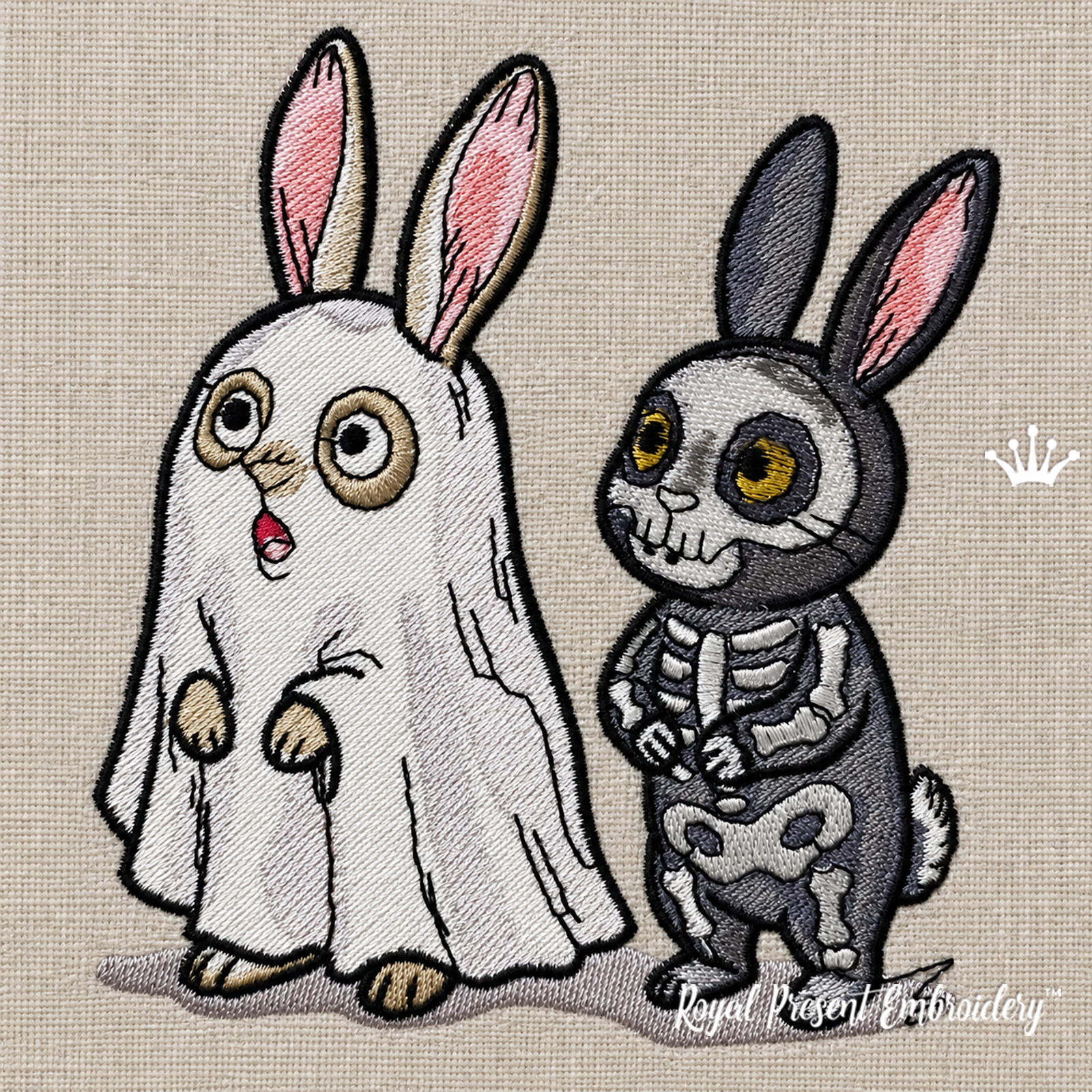
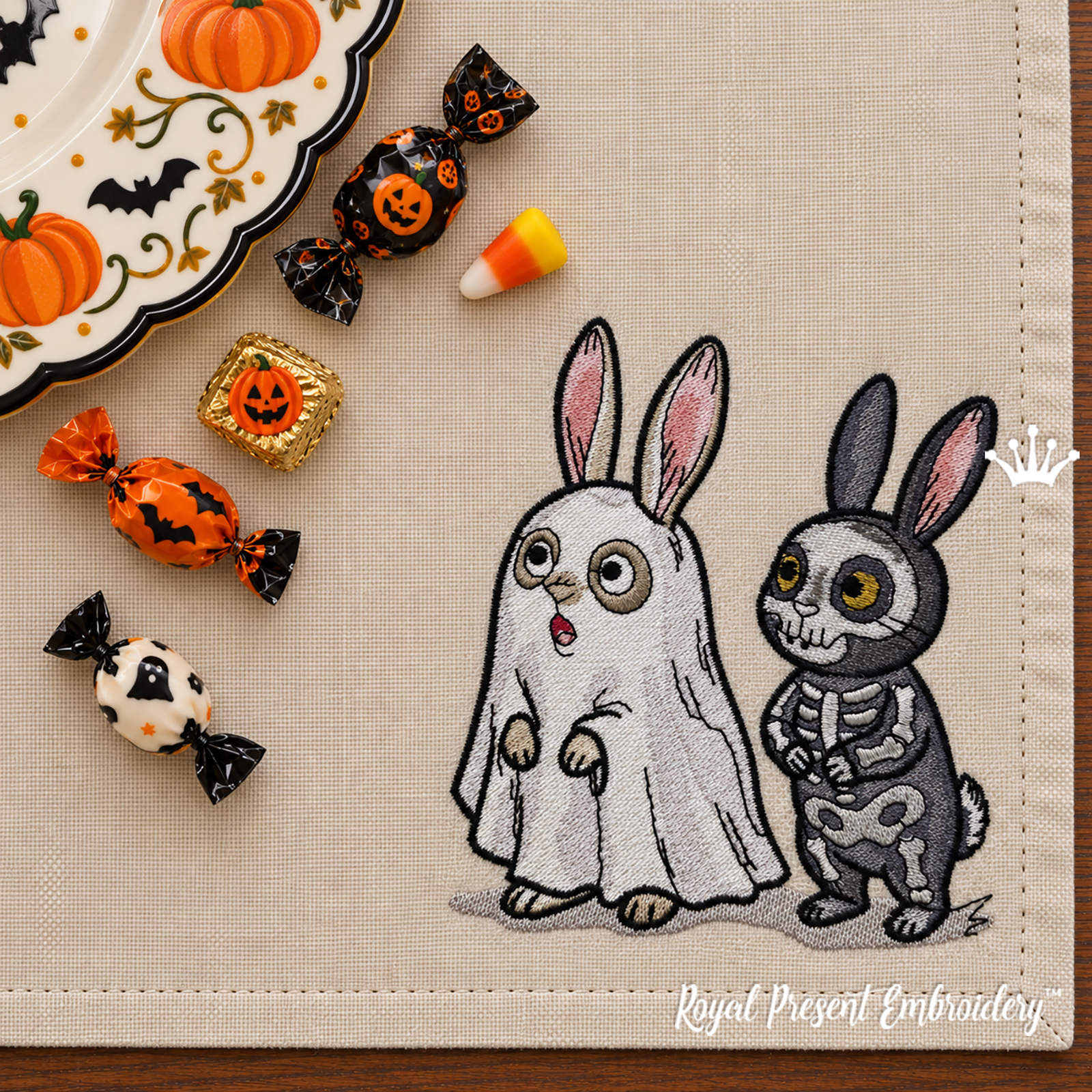
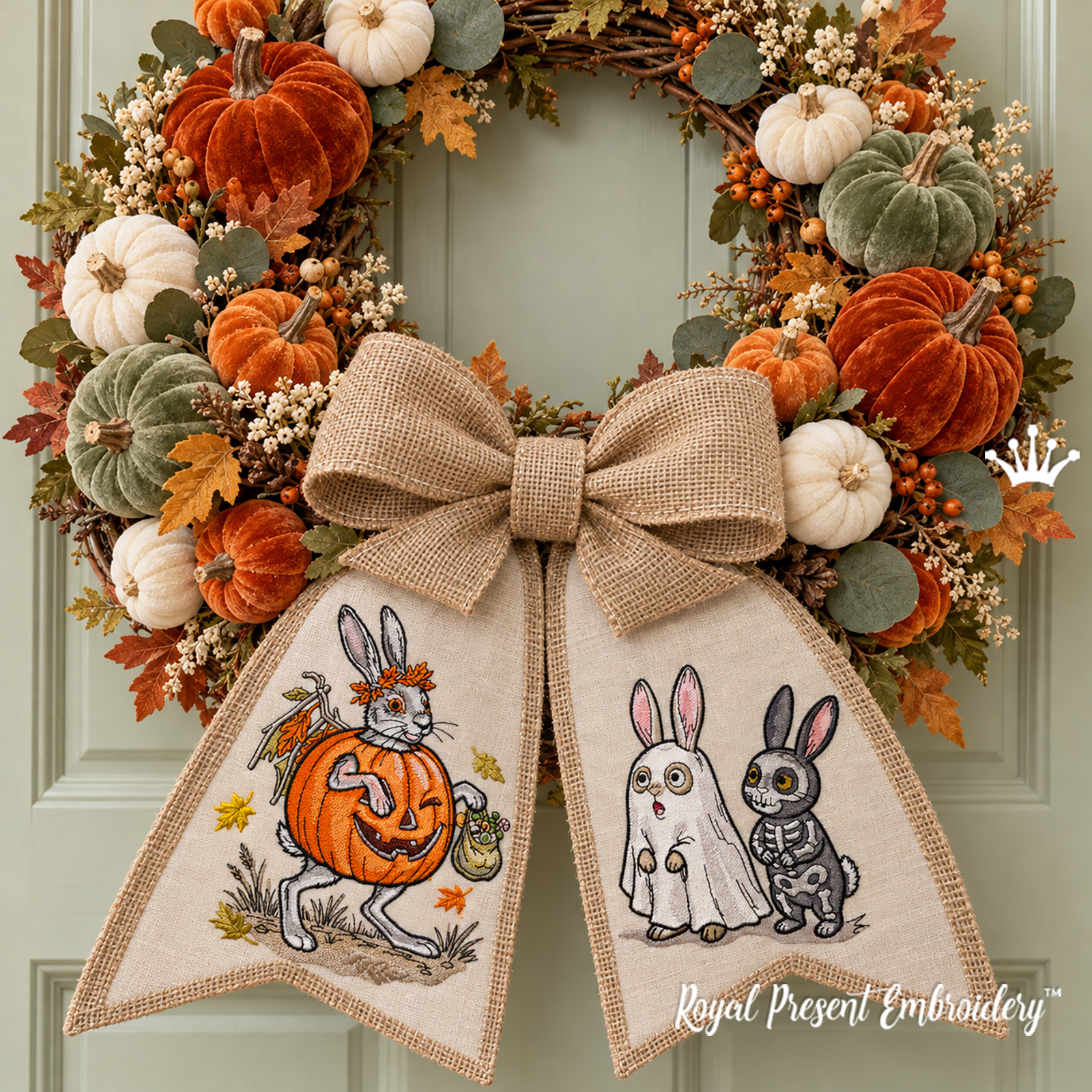
This digital set contains two independent Halloween bunny scenes: a bunny in a pumpkin costume, and a pair of bunnies dressed as a ghost and a skeleton. Each scene is supplied as five separately prepared files. Choose the size from the table for the hoop and placement you need.
The download contains digital files for an embroidery machine, not a finished embroidered item.
Designs included
| Scene | Contents |
|---|---|
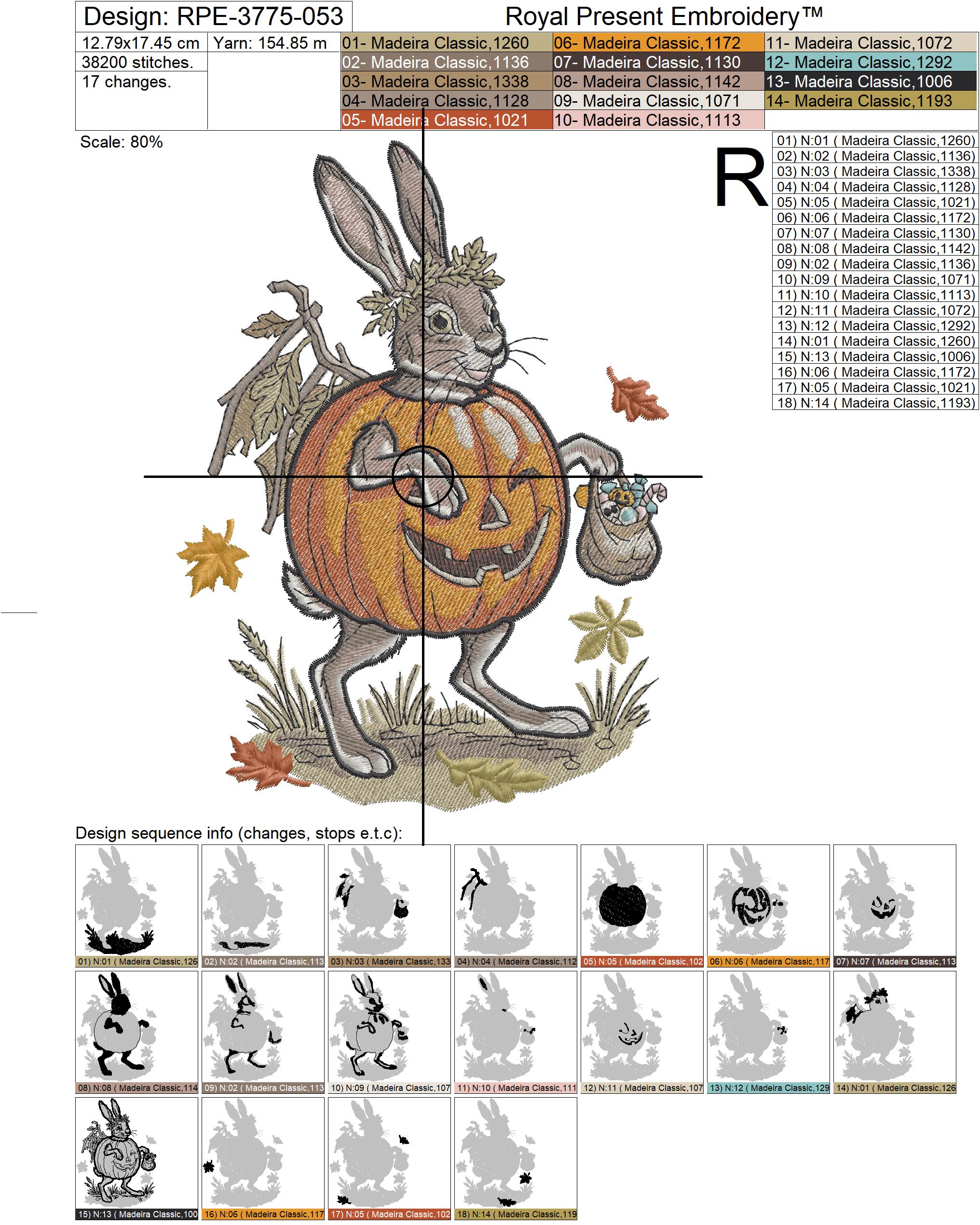
| Bunny in a pumpkin costume | Bunny carrying a candy bag, pumpkin costume, oak leaves, twig and ground details — 5 sizes |
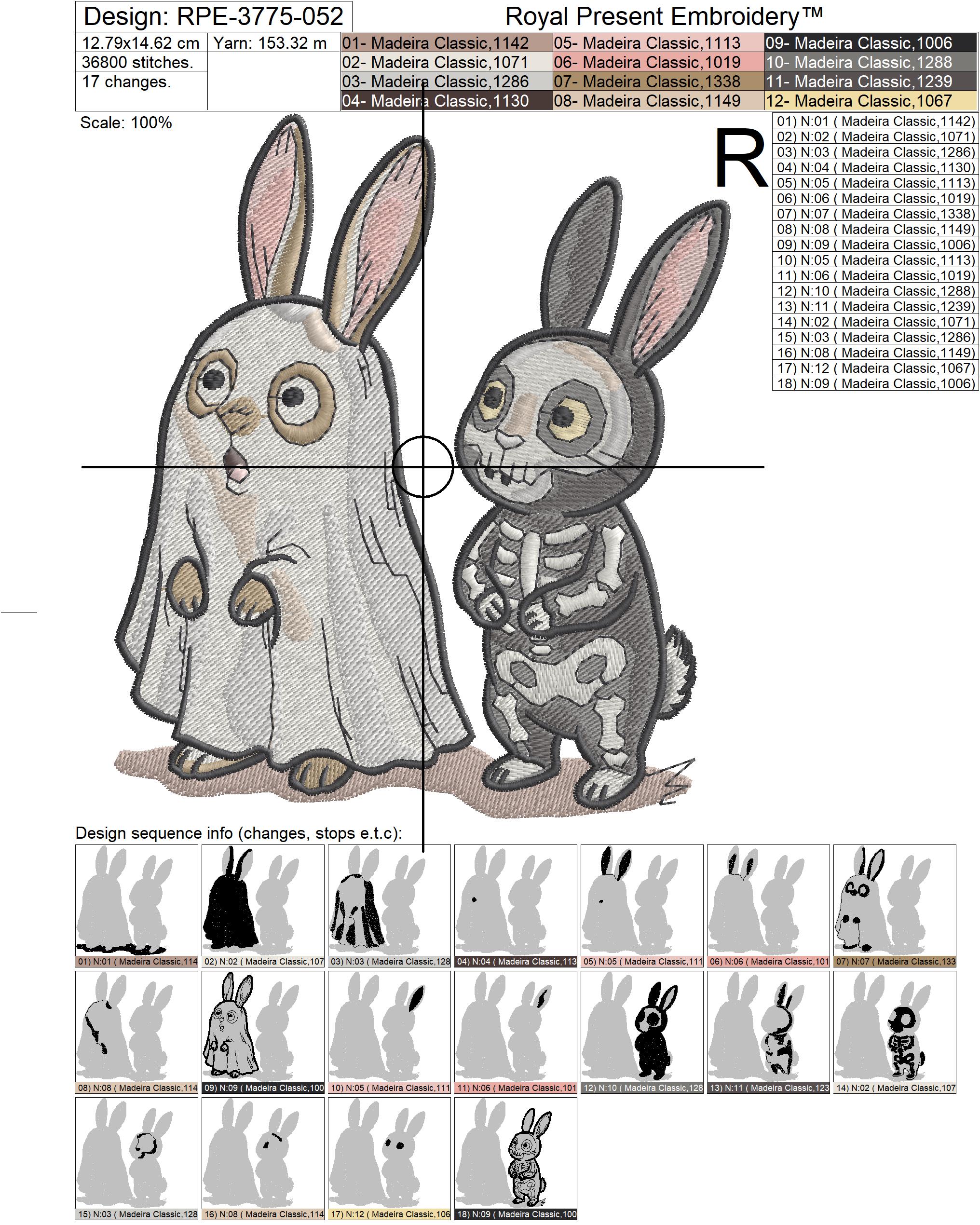
| Ghost and skeleton bunnies | Pair of bunnies in ghost and skeleton costumes — 5 sizes |
Bunny in a pumpkin costume: sizes and compatible hoops
| Size and stitches | Compatible hoop |
|---|---|
| Size: 127.9x174.5 mm (5.04x6.87 "), Stitches: 38200 | 130x180 mm (5x7") |
| Size: 138.5x188.9 mm (5.45x7.44 "), Stitches: 42400 | 140x200 mm (5.5x8") |
| Size: 148.5x198.4 mm (5.85x7.81 "), Stitches: 45900 | 150x240 mm (6x9.5") |
| Size: 158.5x216.1 mm (6.24x8.51 "), Stitches: 51100 | 160x260 mm (6.25x10.25") |
| Size: 168.5x229.8 mm (6.63x9.05 "), Stitches: 55700 | 180x300 mm (7x12") |
Ghost and skeleton bunnies: sizes and compatible hoops
| Size and stitches | Compatible hoop |
|---|---|
| Size: 127.9x146.2 mm (5.04x5.76 "), Stitches: 36800 | 130x180 mm (5x7") |
| Size: 138.4x158.2 mm (5.45x6.23 "), Stitches: 41300 | 140x200 mm (5.5x8") |
| Size: 148.4x169.6 mm (5.84x6.68 "), Stitches: 45900 | 150x240 mm (6x9.5") |
| Size: 158.3x181.0 mm (6.23x7.13 "), Stitches: 50700 | 160x260 mm (6.25x10.25") |
| Size: 168.3x192.4 mm (6.63x7.57 "), Stitches: 55800 | 180x300 mm (7x12") |
Formats: .dst, .jef, .pec, .vip, .hus, .pes, .exp, .sew, .dat, .vp3, .xxx
Madeira Classic 40 thread chart: bunny in a pumpkin costume
The colour squares correspond to the supplied colour chart. Descriptions identify the main element stitched in each colour.
| Colour | Madeira number | Main stitched element |
|---|---|---|
| Madeira Classic 40, 1260 | Ground, grass and shadows near the paws | |
| Madeira Classic 40, 1136 | Grey shadows on the bunny, bag and twig | |
| Madeira Classic 40, 1338 | Warm fur areas, twig and bag | |
| Madeira Classic 40, 1128 | Light bunny and bag areas | |
| Madeira Classic 40, 1021 | Main pumpkin costume and oak leaves | |
| Madeira Classic 40, 1172 | Pumpkin and leaf highlights | |
| Madeira Classic 40, 1130 | Dark shadows, pumpkin face and twig detail | |
| Madeira Classic 40, 1142 | Soft bunny shadows | |
| Madeira Classic 40, 1071 | Light face details and pumpkin cut-outs | |
| Madeira Classic 40, 1113 | Inner ears and warm facial accents | |
| Madeira Classic 40, 1072 | Cream fur and highlight accents | |
| Madeira Classic 40, 1292 | Cool shadow accents | |
| Madeira Classic 40, 1006 | Outlines, pupils and small details | |
| Madeira Classic 40, 1193 | Grass and leaf accents |
Madeira Classic 40 thread chart: ghost and skeleton bunnies
The colour squares correspond to the supplied colour chart. Descriptions identify the main element stitched in each colour.
| Colour | Madeira number | Main stitched element |
|---|---|---|
| Madeira Classic 40, 1142 | Inner ears and soft fur shadows | |
| Madeira Classic 40, 1071 | Ghost costume and light fur | |
| Madeira Classic 40, 1286 | Ghost folds and ground shading | |
| Madeira Classic 40, 1130 | Dark skeleton-costume shadows | |
| Madeira Classic 40, 1113 | Nose and warm facial accents | |
| Madeira Classic 40, 1019 | Inner ears and muzzle shading | |
| Madeira Classic 40, 1338 | Warm fur and costume accent | |
| Madeira Classic 40, 1149 | Ground and costume accent | |
| Madeira Classic 40, 1006 | Outlines, facial features and skeleton bones | |
| Madeira Classic 40, 1288 | Skeleton costume | |
| Madeira Classic 40, 1239 | Shadow beneath the paws | |
| Madeira Classic 40, 1067 | Small light costume accents |
Frequently asked questions
Why are there two separate size tables?
These are two independent scenes with different proportions: the pumpkin-costume bunny is taller, while the ghost-and-skeleton pair is wider. Select a size for each scene separately. When they will appear on the same item, print or trace both files at 100% scale first so their visual heights, not only their hoop sizes, work together.
How can I place both scenes on one project without losing the ground details?
Mark the lower edge of each design from a full-size template and keep that line away from seams, pockets, zips and thick hems. Place the scenes by their ground shadows rather than by the outermost ears; this keeps the pair looking intentional even though their overall outlines differ. Run the machine trace for each placement before stitching.
What stabilizer suits cotton, linen or knit for these detailed scenes?
Use the fabric weight divided by 3 as a starting point for total backing support. For example, 180 g/m² fabric (about 5.3 oz/yd²) calls for roughly 60 g/m² (about 1.8 oz/yd²) of support. On stable cotton or firm linen, begin with Madeira Cotton Soft. For loose linen, canvas, knitwear or a panel that shifts in the hoop, use Gunold Stiffy 2040 Cut Away. A light coat of Gunold KK 100 on the backing can keep layers from moving; it supports hooping but never replaces stabilizer.
How do I keep the faces and skeleton details visible on terry or velour?
Use a medium cut-away backing such as Gunold Stiffy 2040 Cut Away underneath and Sulky Solvy water-soluble topping above the pile. Hoop the layers without stretching the base. The topper keeps the narrow face, bone and outline stitches above the surface; remove excess after stitching and dissolve the remaining film according to the topper instructions.

 Get Sign-In Link
 Login with Google
 Login with Facebook
 Login with Amazon
 Login with Paypal