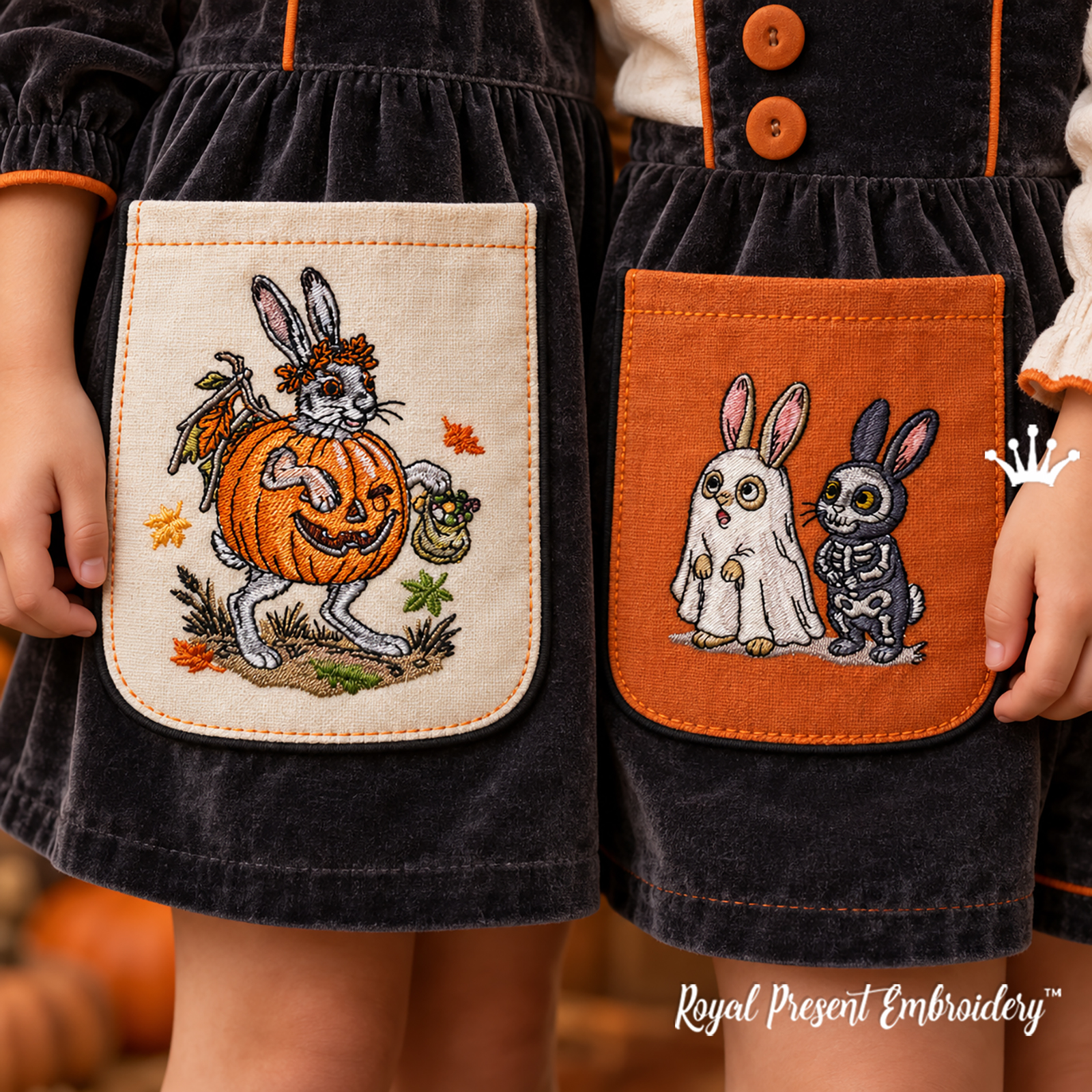
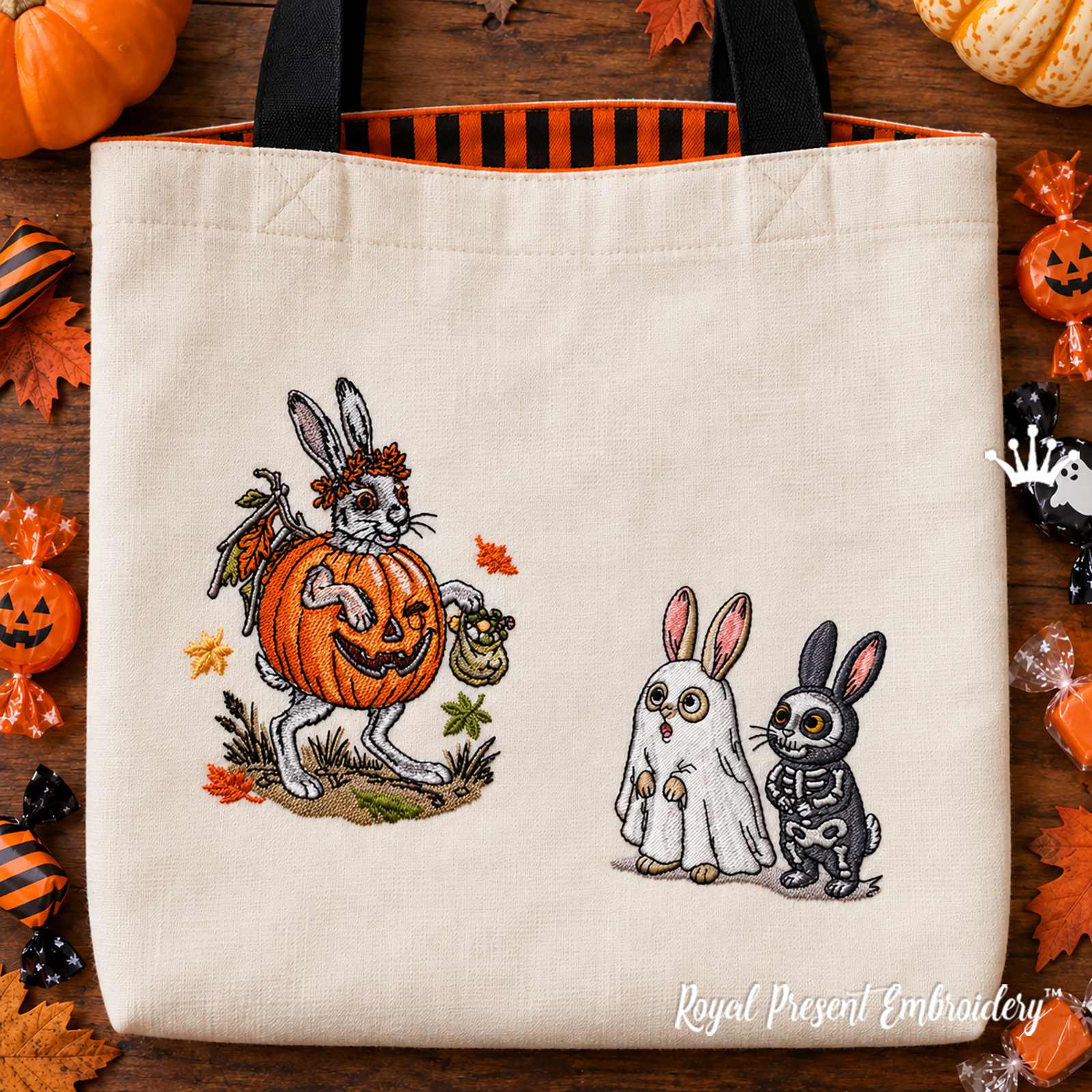
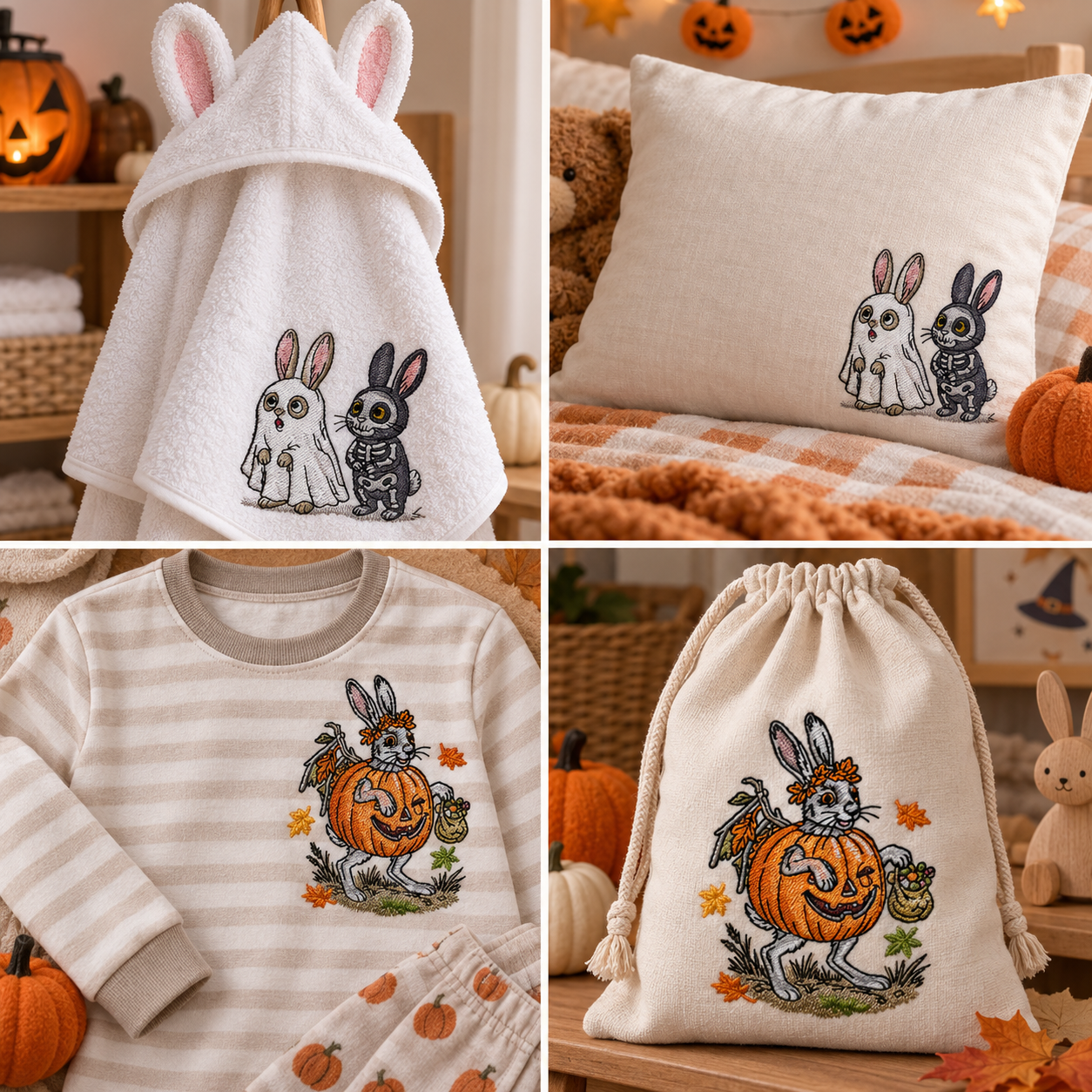
This digital set brings together two small Halloween bunny scenes: an autumn bunny with a jack-o'-lantern, and a pair of bunnies dressed as a ghost and a skeleton. Both motifs are supplied as separate, ready-to-stitch files.
Each motif has five prepared sizes. The smallest file fits an 80x80 mm (3x3 in) hoop; the largest fits a 130x180 mm (5x7 in) hoop. Select the file that fits your hoop and planned placement.
What the download includes
| Product type | Digital machine embroidery design set |
| Motif 1 | Small Autumn Bunny with Jack-o'-Lantern — 5 sizes |
| Motif 2 | Small Halloween Ghost and Skeleton Bunnies — 5 sizes |
| Total | 10 separately prepared embroidery files |
| Delivery | Digital ZIP download; no finished item is shipped |
Sizes and compatible hoops
Small Autumn Bunny with Jack-o'-Lantern
| Size and stitches | Compatible hoop |
|---|---|
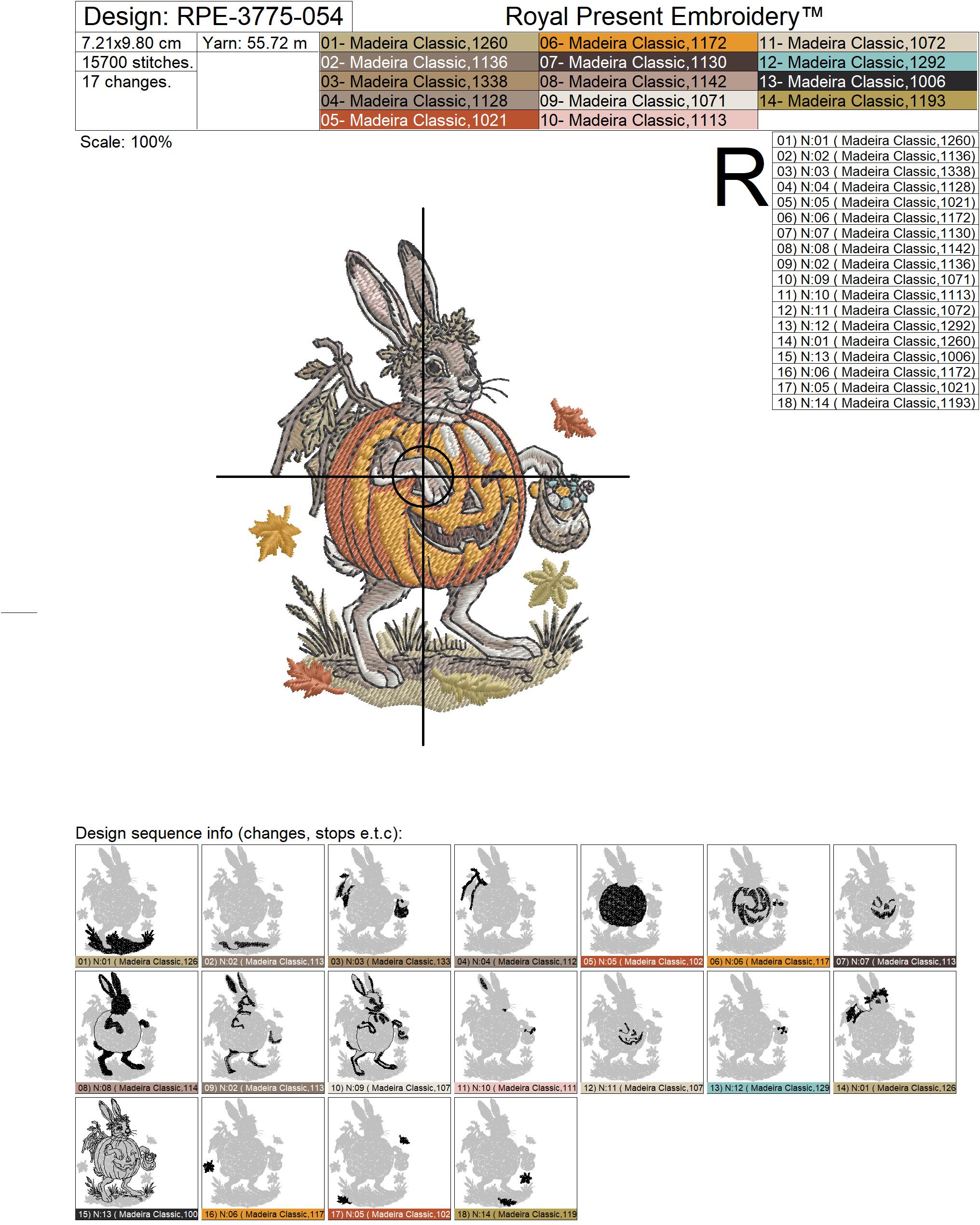
| Size: 72.1x98.0 mm (2.84x3.86 "), Stitches: 15700 | 100x100 mm (4x4 in) |
| Size: 79.3x107.8 mm (3.12x4.24 "), Stitches: 17700 | 100x170 mm (4x7 in) |
| Size: 87.1x118.6 mm (3.43x4.67 "), Stitches: 19700 | 100x170 mm (4x7 in) |
| Size: 95.7x130.4 mm (3.77x5.13 "), Stitches: 22300 | 100x170 mm (4x7 in) |
| Size: 105.3x143.4 mm (4.15x5.65 "), Stitches: 25300 | 130x180 mm (5x7 in) |
Small Halloween Ghost and Skeleton Bunnies
| Size and stitches | Compatible hoop |
|---|---|
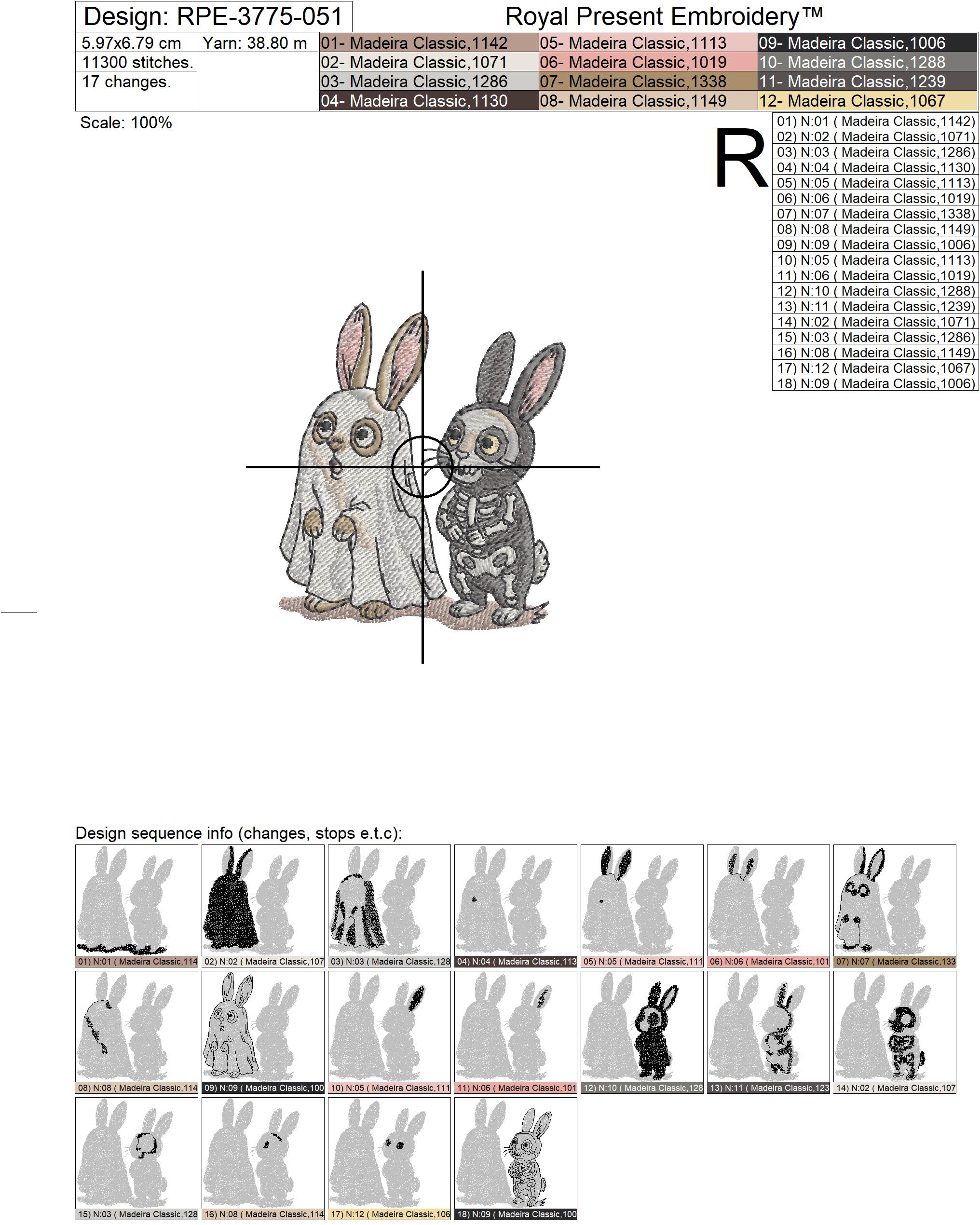
| Size: 59.7x67.9 mm (2.35x2.67 "), Stitches: 11300 | 80x80 mm (3x3 in) |
| Size: 65.5x74.7 mm (2.58x2.94 "), Stitches: 12600 | 80x80 mm (3x3 in) |
| Size: 72.0x82.3 mm (2.83x3.24 "), Stitches: 14200 | 100x100 mm (4x4 in) |
| Size: 79.2x90.4 mm (3.12x3.56 "), Stitches: 16100 | 100x100 mm (4x4 in) |
| Size: 86.0x98.3 mm (3.39x3.87 "), Stitches: 18000 | 100x100 mm (4x4 in) |
Formats: .dst, .jef, .pec, .vip, .hus, .pes, .exp, .sew, .dat, .vp3, .xxx
More Bunny Stories
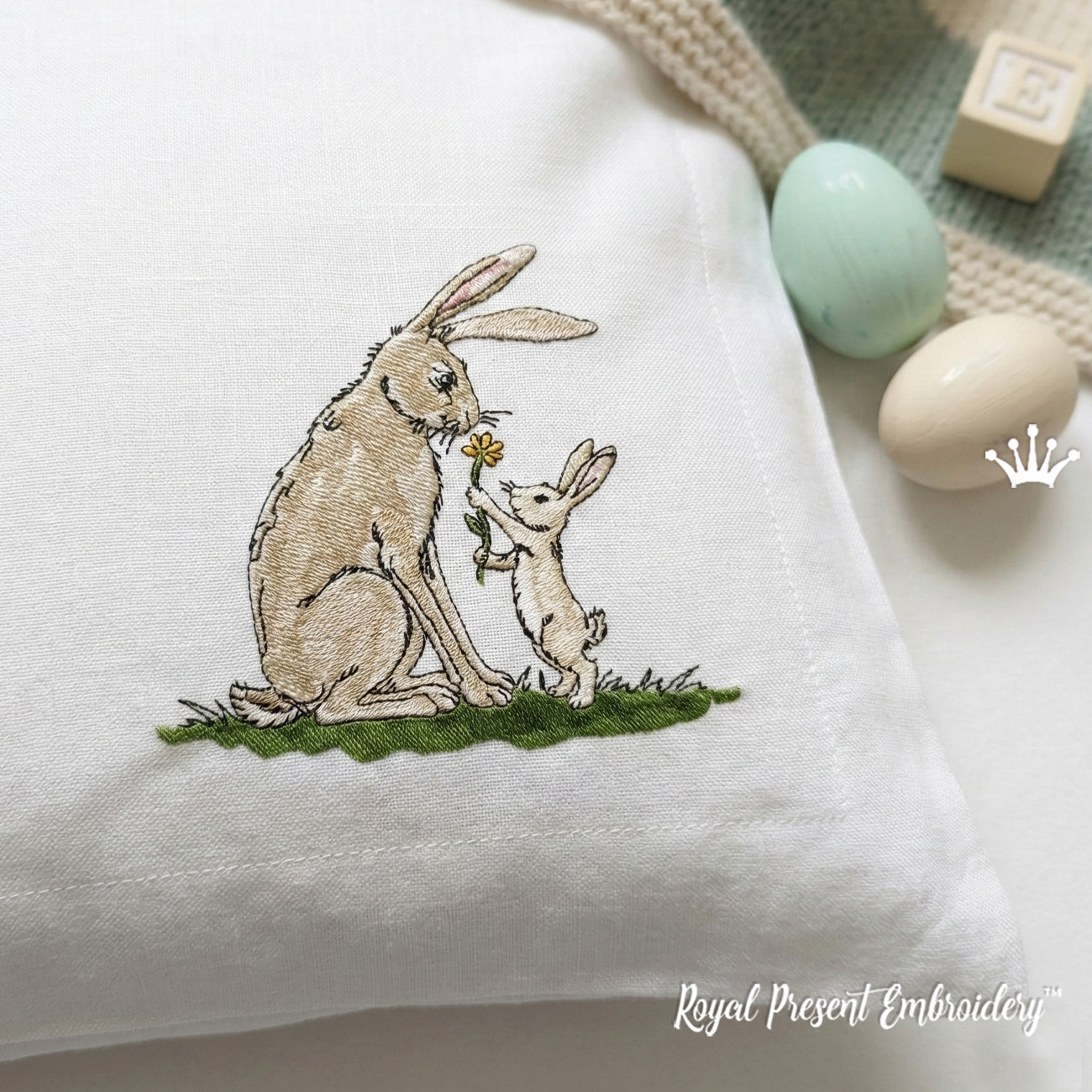 Mother Rabbit and Baby Bunny with Flower Mother Rabbit and Baby Bunny with Flower |
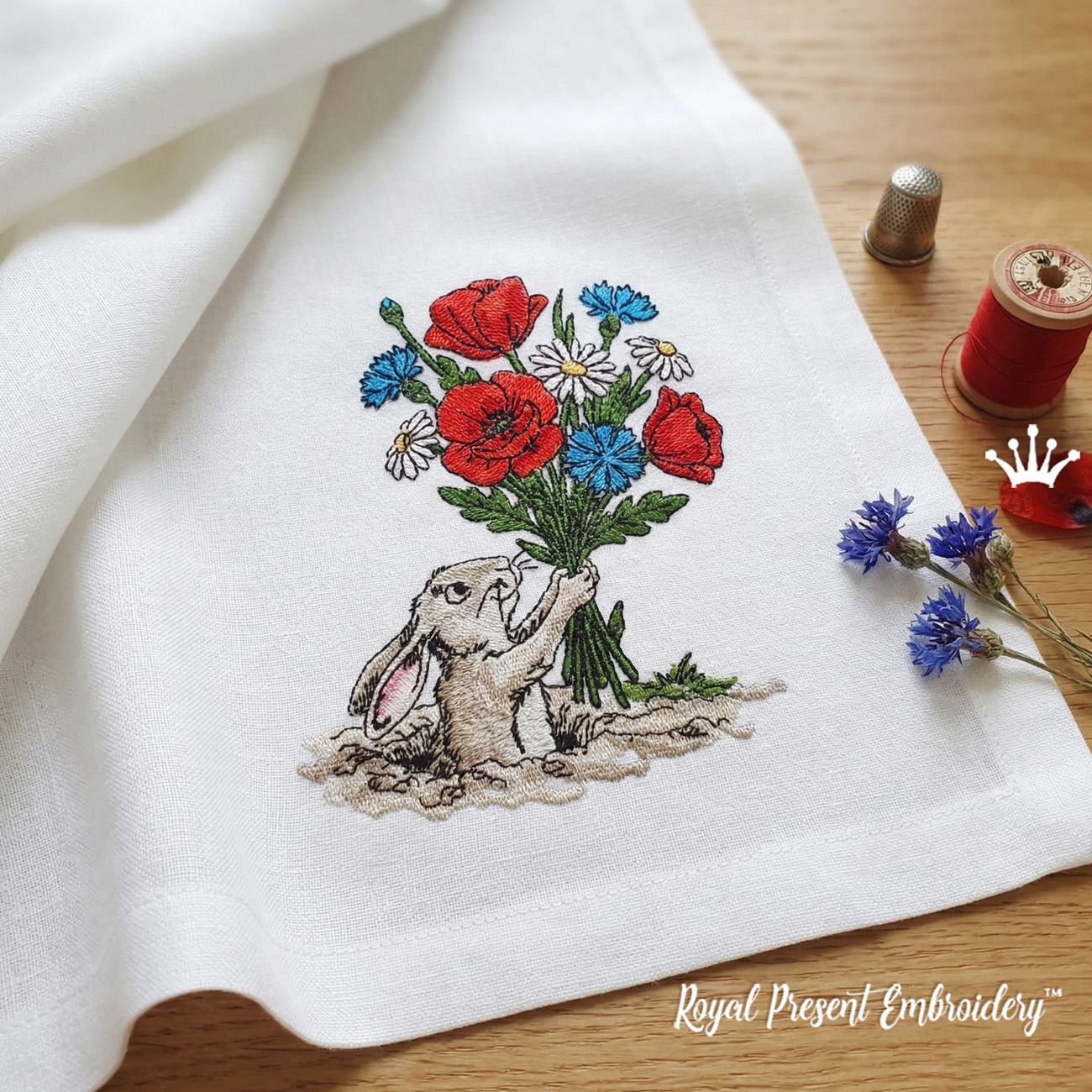 Rabbit with a Bouquet of Poppies, Daisies and Cornflowers Rabbit with a Bouquet of Poppies, Daisies and Cornflowers |
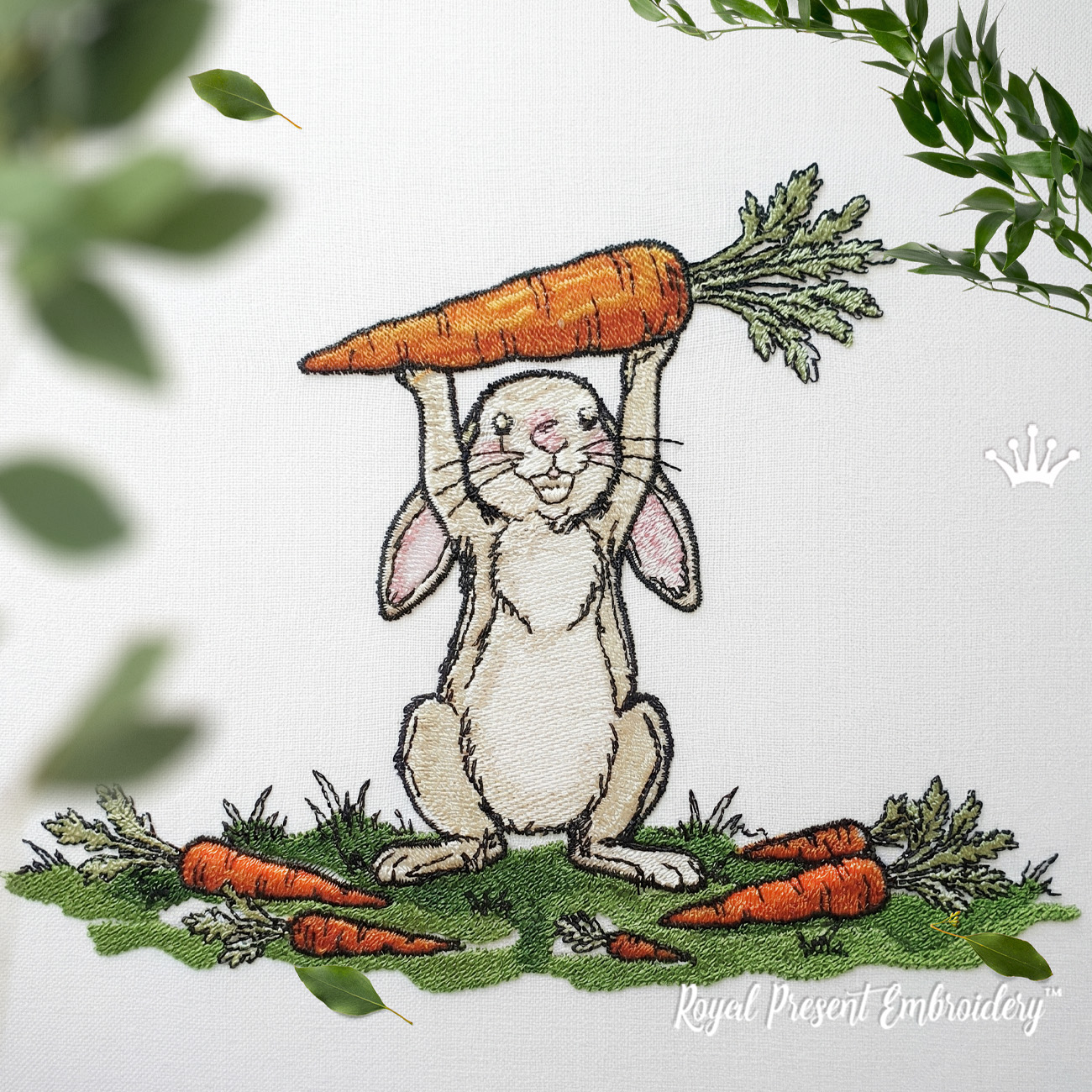 Gardener Bunny Gardener Bunny |
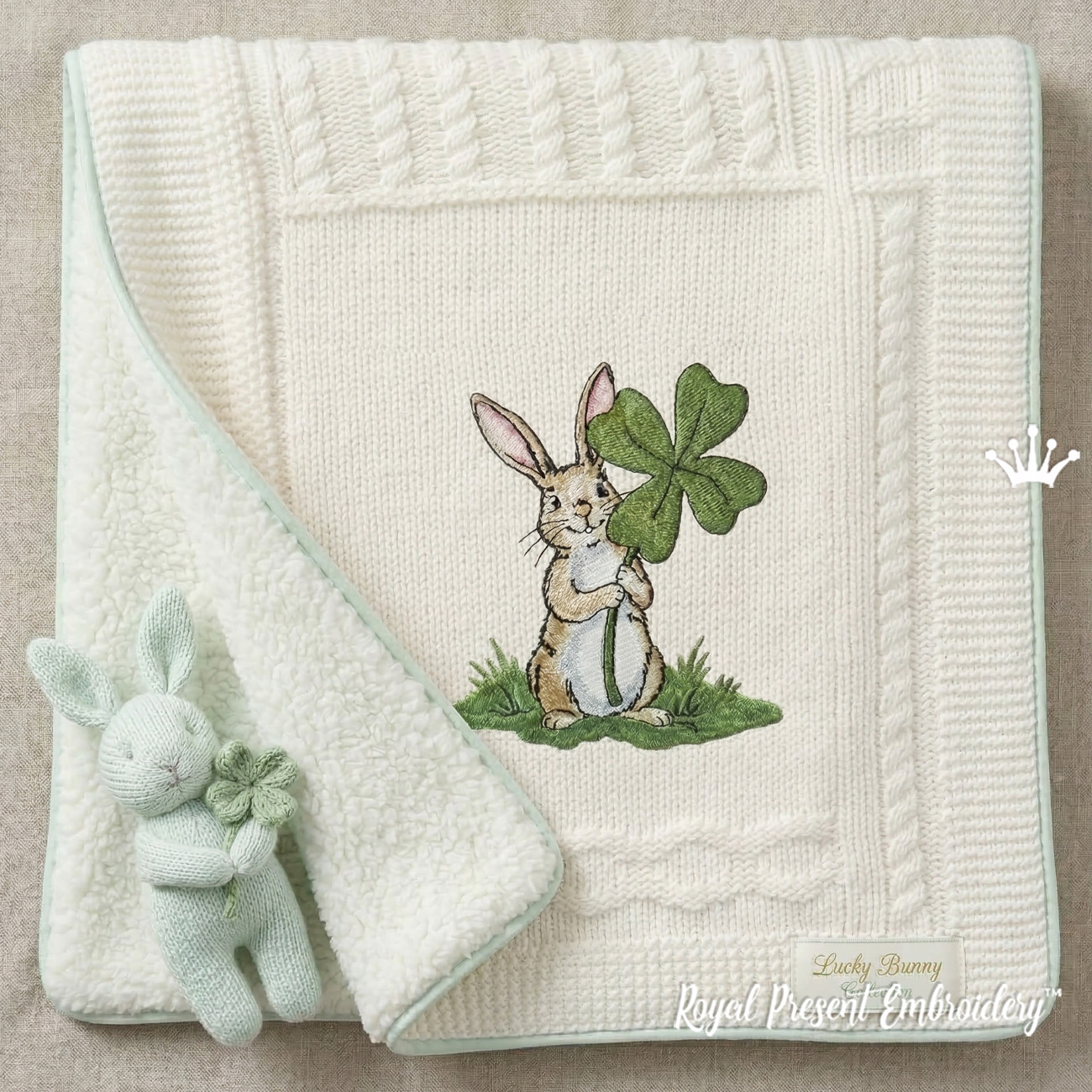 Cute Rabbit with Shamrock Cute Rabbit with Shamrock |
Madeira Classic 40 Thread Chart: Small Autumn Bunny with Jack-o'-Lantern
Each Madeira number is paired with the element it stitches. The color squares correspond to the supplied color chart.
| Color | Madeira number | Design element |
|---|---|---|
| Madeira Classic 40, 1260 | Ground, grass and shadows near the paws | |
| Madeira Classic 40, 1136 | Gray shadows on the bunny, pouch and twig | |
| Madeira Classic 40, 1338 | Warm fur areas, twig and pouch | |
| Madeira Classic 40, 1128 | Light areas of the bunny and pouch | |
| Madeira Classic 40, 1021 | Main orange of the pumpkin and maple leaves | |
| Madeira Classic 40, 1172 | Yellow-orange pumpkin and leaf areas | |
| Madeira Classic 40, 1130 | Dark shadows, pumpkin features and twig detail | |
| Madeira Classic 40, 1142 | Gray-pink bunny shadows | |
| Madeira Classic 40, 1071 | Light facial details and the carved pumpkin mask | |
| Madeira Classic 40, 1113 | Inner ears and small warm facial accents | |
| Madeira Classic 40, 1072 | Cream highlights on fur and leaves | |
| Madeira Classic 40, 1292 | Cool gray-green accents and leaf shadows | |
| Madeira Classic 40, 1006 | Black outlines, eyes and fine details | |
| Madeira Classic 40, 1193 | Golden details on the twig, pouch and leaves |
Madeira Classic 40 Thread Chart: Small Halloween Ghost and Skeleton Bunnies
Each Madeira number is paired with the element it stitches. The color squares correspond to the supplied color chart.
| Color | Madeira number | Design element |
|---|---|---|
| Madeira Classic 40, 1142 | Ground shadow below the paws | |
| Madeira Classic 40, 1071 | Light ghost costume base and white bones | |
| Madeira Classic 40, 1286 | Light-gray ghost shadows and skeleton highlights | |
| Madeira Classic 40, 1130 | Dark ghost shadows and facial details | |
| Madeira Classic 40, 1113 | Pale-pink inner ears | |
| Madeira Classic 40, 1019 | Pink ear shading and small nose | |
| Madeira Classic 40, 1338 | Warm beige paws and face areas | |
| Madeira Classic 40, 1149 | Shadows on paws, face and facial planes | |
| Madeira Classic 40, 1006 | Black outlines, pupils and fine details of both bunnies | |
| Madeira Classic 40, 1288 | Gray base of the skeleton-costume bunny | |
| Madeira Classic 40, 1239 | Dark skeleton-bunny shadows | |
| Madeira Classic 40, 1067 | Yellow irises of the skeleton bunny |
Placement and stabilization
Print the selected file at 100% before hooping and mark the center of that specific motif. The pumpkin bunny is tall, while the ghost-and-skeleton pair is compact and almost square. Trace each motif on the machine before stitching so ears, leaves, the twig, tail and ground shadow do not land on a seam, zipper, pocket edge or drawstring channel.
Choose stabilizer by fabric structure, not by the number of thread colors. For stable cotton or firm linen, start with a medium tear-away such as Madeira Cotton Soft. A useful starting point for total backing weight is fabric weight ÷ 3: 180 g/m² fabric, about 5.3 oz/yd², calls for roughly 60 g/m², about 1.8 oz/yd², of stabilizer. For loose linen, canvas, knit, or any fabric that shifts in the hoop, use a medium cut-away such as Gunold Stiffy 2040 Cut Away. Apply a light coat of Gunold KK 100 to the stabilizer away from the machine only when the layers need help staying together.
Frequently asked questions
Why are there two separate size tables?
These are two independent motifs, not two parts of one image. The autumn bunny runs from 72.1x98.0 mm to 105.3x143.4 mm, while the ghost-and-skeleton pair runs from 59.7x67.9 mm to 86.0x98.3 mm. Choose one suitable file for each motif if you want to stitch both on the same project.
How should I place both motifs on one item so they look intentional?
Print both selected templates at 100% and arrange them on the finished item before hooping. Align by the full silhouette, not by the edge of a hoop: the pumpkin bunny extends sideways with leaves and a pouch, while the pair extends with ears and the ground shadow. Trace the first motif, then rehoop and trace the second before stitching.
How do I keep the small faces and pumpkin details visible on terry, fleece or velour?
Float a water-soluble topping such as Sulky Solvy over the pile and secure it with a basting box. It holds the pile down so eyes, whiskers, pumpkin teeth, leaves and white bones do not sink into the surface. Choose the backing for the base fabric: a stretch or loose fabric usually needs Gunold Stiffy 2040 Cut Away. Remove the topping slowly after embroidery rather than pulling against fine outlines.
Can I embroider these small designs on an already sewn patch pocket?
Only if you can keep the front of the pocket separate from its back. If the construction permits, open a small section of the pocket seam so its front lies flat, embroider it, then close the seam again. Do not hoop both pocket layers together: the needle will stitch the pocket shut. On a bulky finished item, use an appropriate magnetic or clamp hoop and Gunold KK 100 only to hold the fabric to the stabilizer.

 Get Sign-In Link
 Login with Google
 Login with Facebook
 Login with Amazon
 Login with Paypal