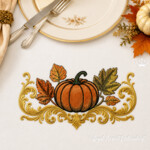
Fall Pumpkin Baroque Border with Golden Scrolls and Leaves Machine Embroidery Design - 5 Sizes
By knowing the speed of your embroidery machine, you can find out how long it will take to embroider a design.
To use the embroidery calculator, click on the number of stitches in the product description.
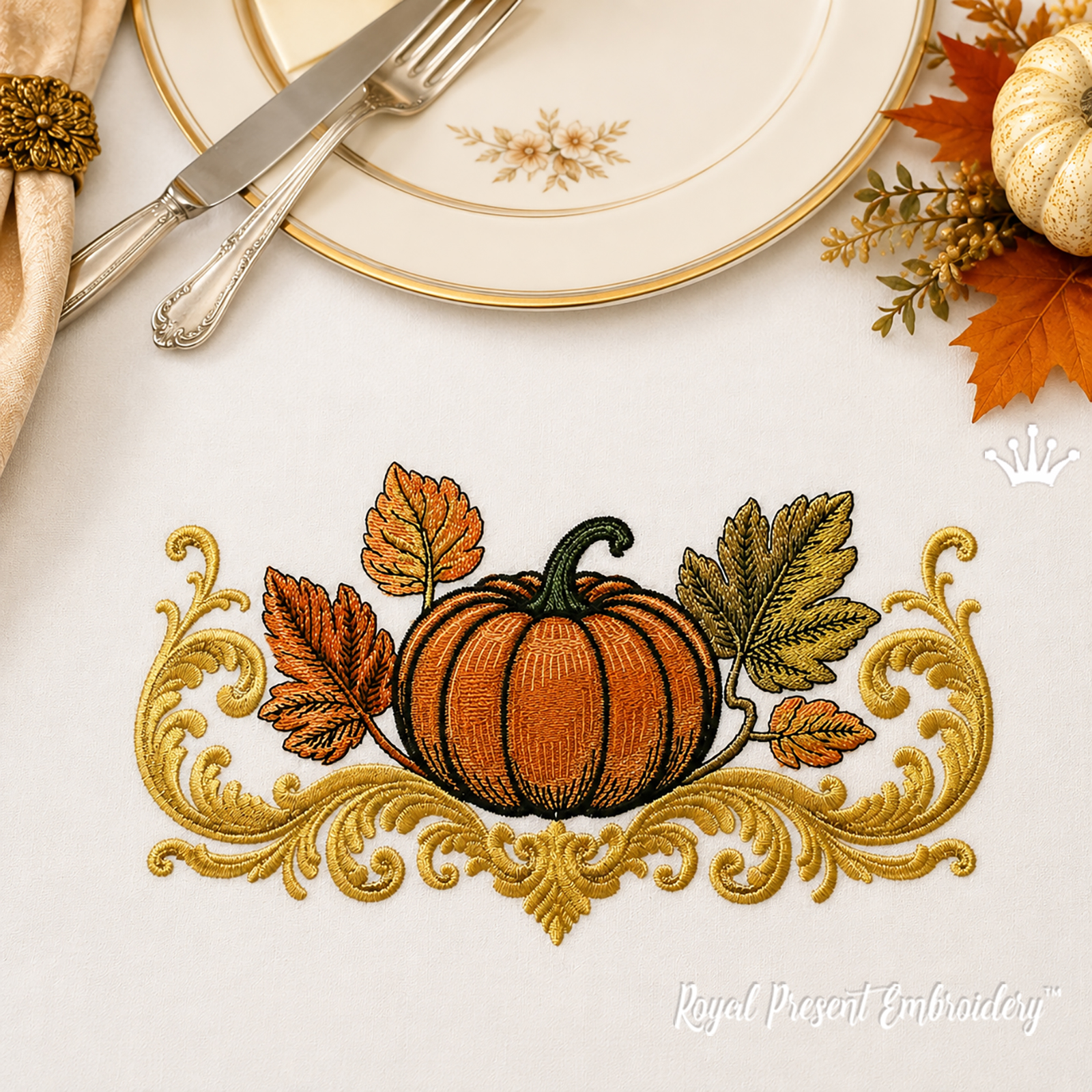
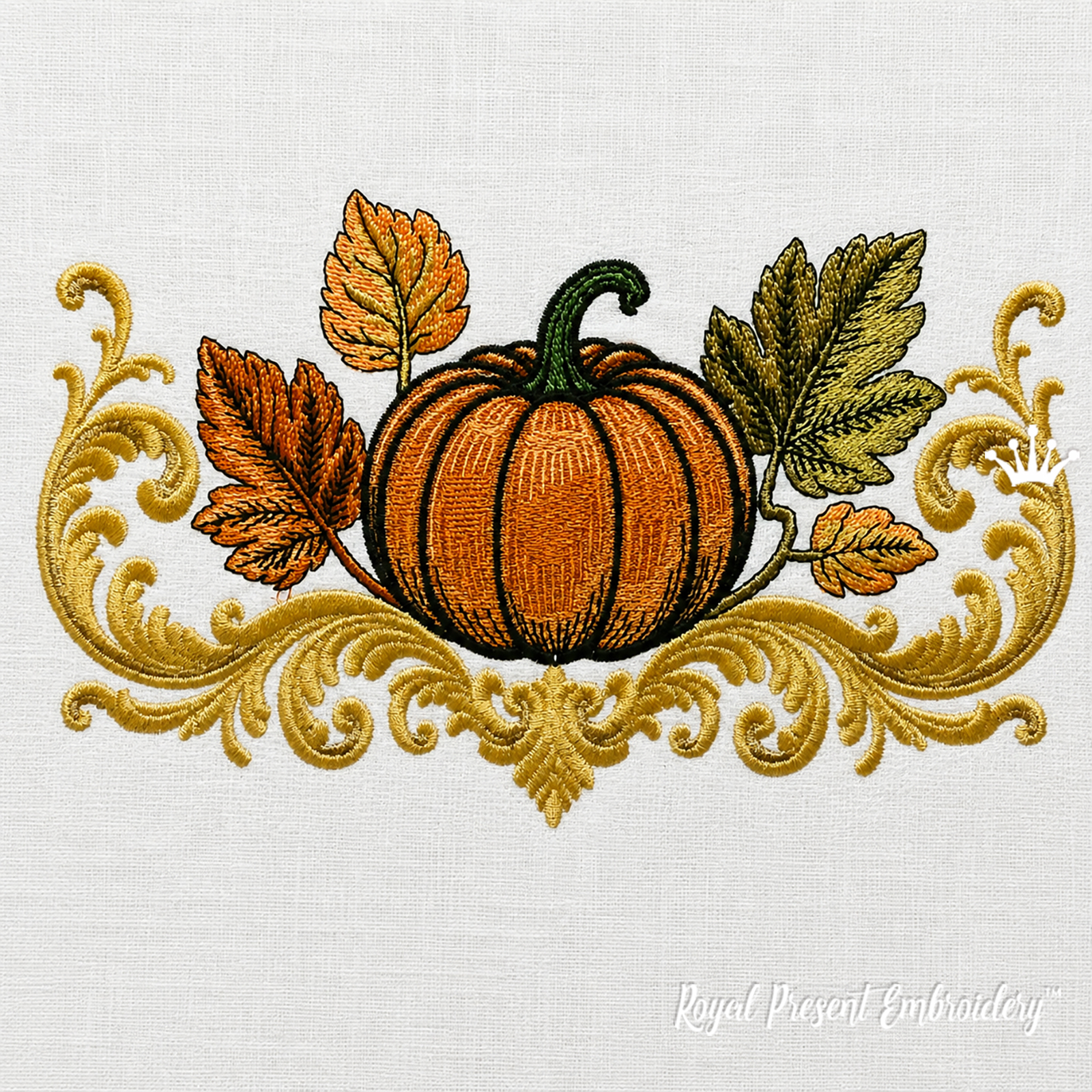
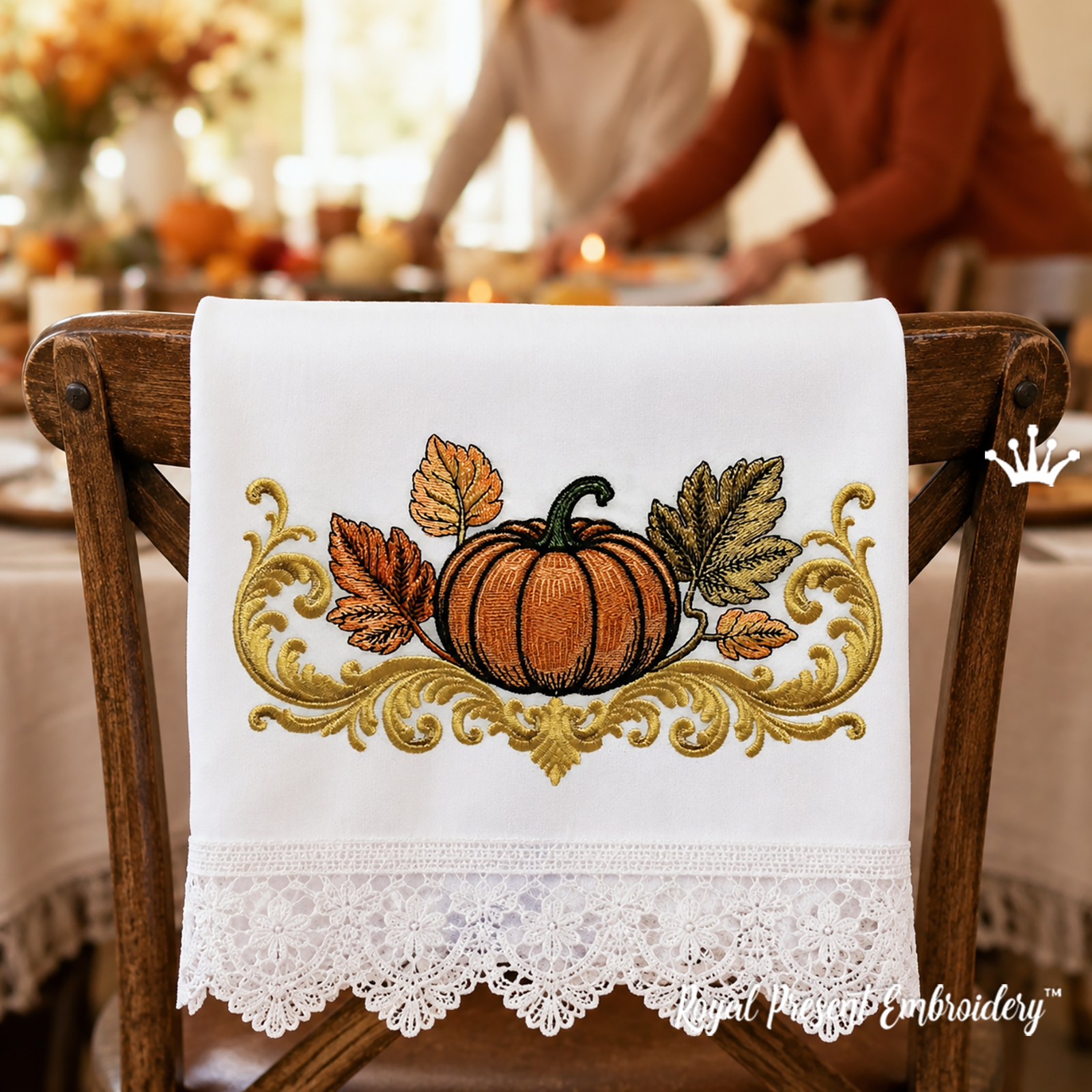
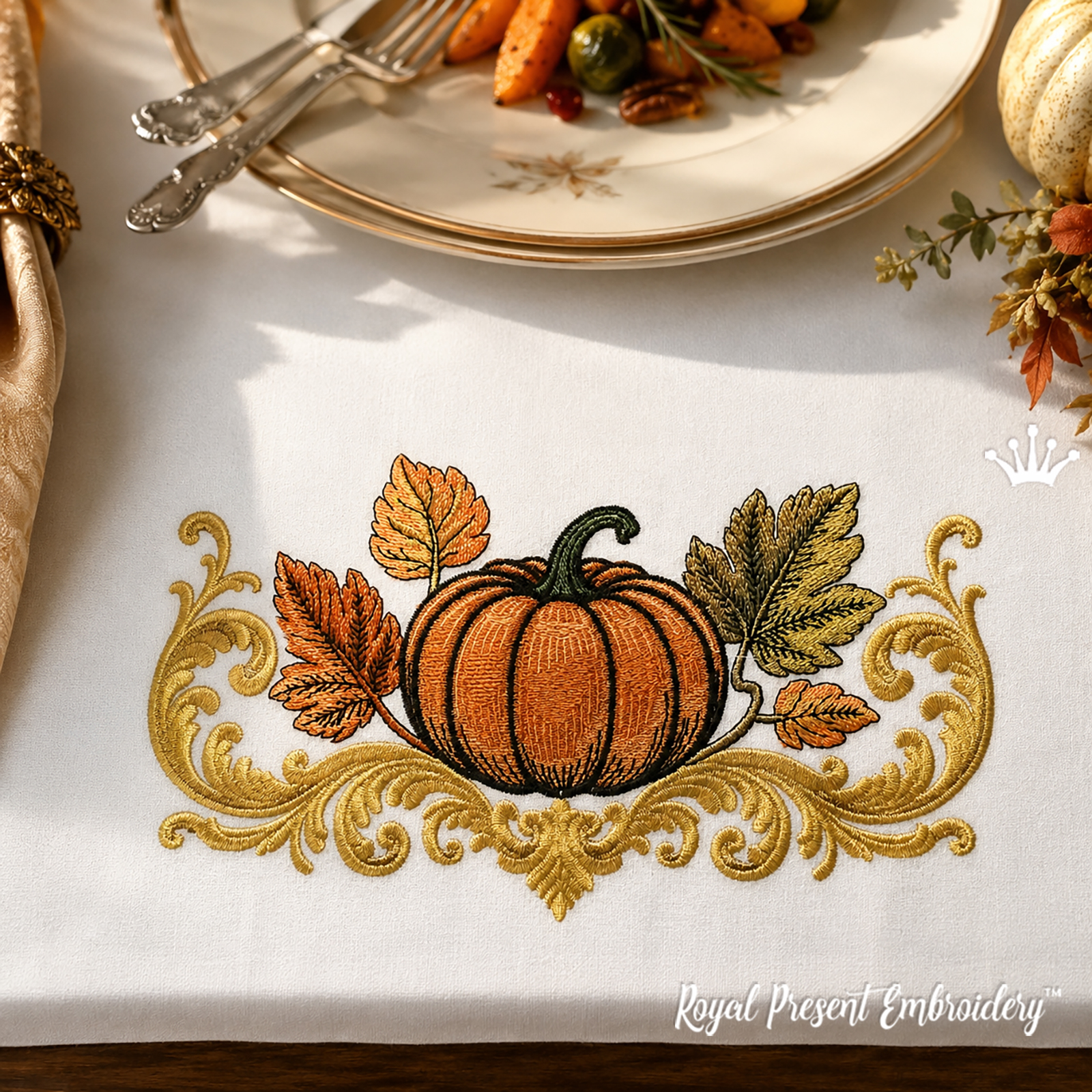
Fall Pumpkin Baroque Border with Golden Scrolls and Leaves is a digital machine embroidery design built as a decorative border composition rather than a simple centered pumpkin motif. A shaded orange pumpkin sits between autumn leaves and sweeping gold baroque scrollwork, giving the design a strong finished edge for towels, table runners, placemats, table linens, pillow bands, aprons, bags and seasonal clothing. Five prepared sizes include both horizontal and vertical layouts. You receive digital files for an embroidery machine, not a finished embroidered item.
Sizes and stitch counts
Size: 95.7x178.0 mm (3.77x7.01"), Stitches: 36700
Size: 198.6x106.9 mm (7.82x4.21"), Stitches: 42000
Size: 117.6x218.6 mm (4.63x8.61"), Stitches: 47200
Size: 128.4x238.6 mm (5.06x9.39"), Stitches: 52400
Size: 139.2x258.6 mm (5.48x10.18"), Stitches: 57900
Formats: .dst, .jef, .pec, .vip, .hus, .pes, .exp, .sew, .dat, .vp3, .xxx
What is included
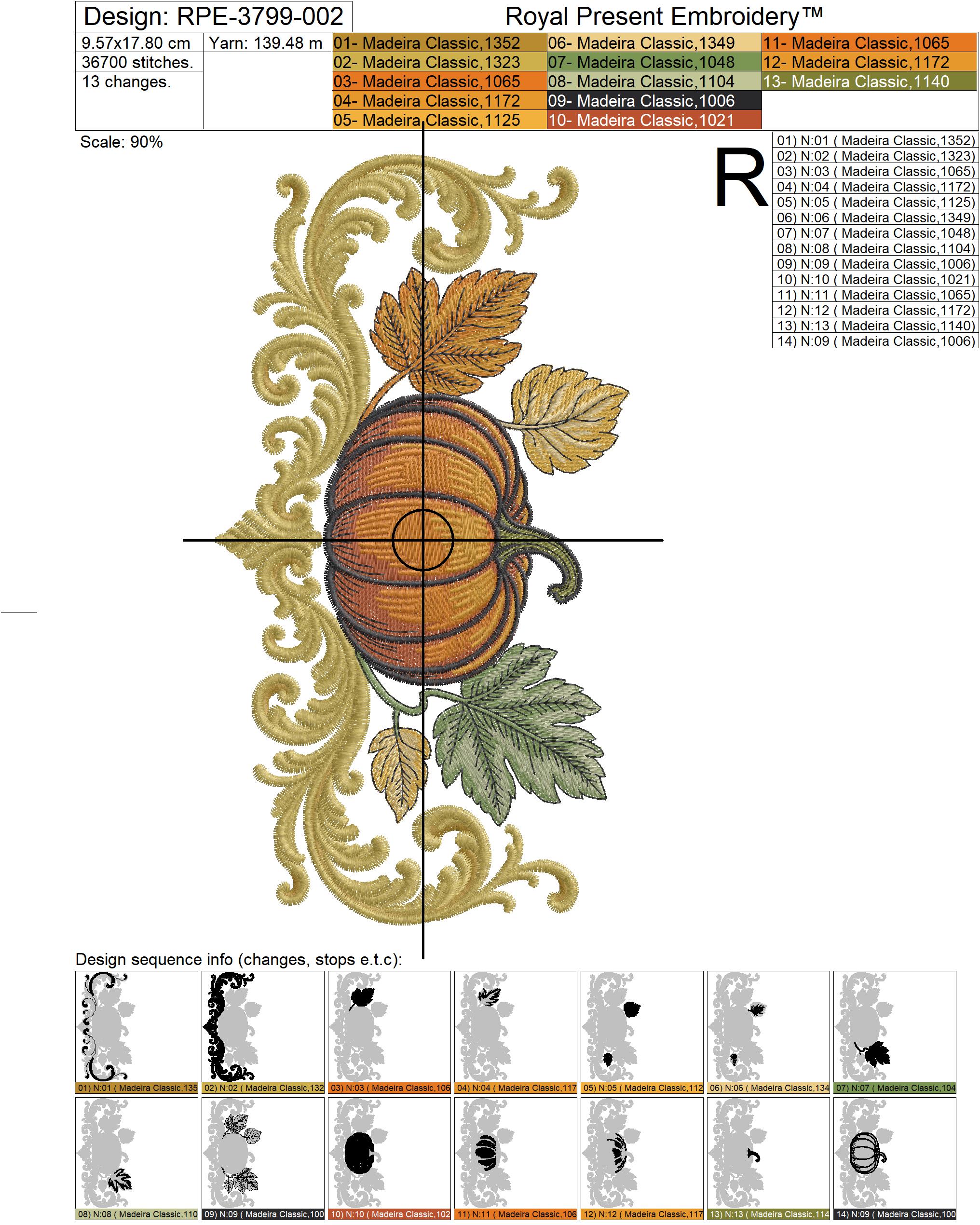
The ZIP archive includes the five prepared design sizes and their JPG production color charts. After downloading, unzip the archive and select the machine format supported by your embroidery machine.
This is a digital product. Fabric, thread, stabilizer, hoops and finished embroidered items are not included.
Hoop sizes
Design size 95.7x178.0 mm — hoop 130x180 mm (5x7")
Design size 198.6x106.9 mm — hoop 140x200 mm (5.5x8")
Design size 117.6x218.6 mm — hoop 160x240 mm (6.3x9.45")
Design size 128.4x238.6 mm — hoop 160x240 mm (6.3x9.45")
Design size 139.2x258.6 mm — hoop 160x260 mm (6.3x10.24")
Madeira Classic Rayon 40 color chart
The production chart uses 11 unique Madeira Classic Rayon 40 colors. Each color is listed once below with the part of the design it stitches. The screen swatch is only a visual guide; use the Madeira number as the primary reference.
|
Madeira Classic 1352 | Light gold sections of the baroque scrollwork. | |
|
Madeira Classic 1323 | Deeper gold shading in the scrollwork and ornamental curls. | |
|
Madeira Classic 1065 | Bright orange fall leaves and lighter pumpkin segments. | |
|
Madeira Classic 1172 | Golden-orange leaf details and additional pumpkin shading. | |
|
Madeira Classic 1125 | Warm golden accents in the leaves and pumpkin. | |
|
Madeira Classic 1349 | Pale gold highlights and lighter leaf details. | |
|
Madeira Classic 1048 | Main olive-green fill of the large green leaf. | |
|
Madeira Classic 1104 | Lighter green leaf areas and botanical highlights. | |
|
Madeira Classic 1006 | Dark leaf veins, pumpkin outlines and final graphic contouring. | |
|
Madeira Classic 1021 | Main terracotta-orange fill of the pumpkin. | |
|
Madeira Classic 1140 | Pumpkin stem and green connecting vine. |
If you use another thread brand, use the free Madeira Thread Exchange converter to find the closest available matches. Screen color is not an exact substitute for a physical thread chart.
Why this design works as a border
The gold scrollwork extends beyond the pumpkin and creates a clear decorative edge, so the design can be used as a single border accent without repeating it. The 198.6x106.9 mm version is the most natural horizontal option for a towel end, placemat, runner band or apron. The taller versions work well at the end of a table runner, on a decorative towel, on a narrow textile panel or as a vertical garment accent.
This is not an endless or mathematically seamless border. For a longer composition, use separate placements, mirrored pairs or coordinated companion borders rather than expecting the ends to join automatically.
Where to embroider it
- guest towel, kitchen towel or decorative hand towel;
- table runner end, placemat, large napkin or buffet linen;
- tablecloth corner or one decorative panel on each end of a tablecloth;
- pillow band, cushion front, tote bag or fabric wall panel;
- apron bib or lower apron border;
- wide woven sash, skirt panel, jacket yoke or a Thanksgiving costume detail for a child;
- seasonal banner, mantel textile or harvest-theme gift project.
A full embroidered perimeter on a large tablecloth is possible, but it is a major thread-and-time project: one placement already contains 36700–57900 stitches. For most tablecloths, one or two well-positioned border accents will look cleaner and keep the fabric lighter.
Fabric and stabilizer
For stable woven linen, cotton, twill or gabardine, tear-away backing is the first choice. A useful starting formula is fabric weight ÷ 3 ≈ backing weight. In US units, a 6 oz/yd² linen gives a starting target of about 2 oz/yd² backing; a 4.5 oz/yd² linen gives about 1.5 oz/yd².
For lighter stable linen, Madeira E-Zee Tear Soft 1.5 oz or Sulky Tear-Easy is a sensible starting point. For 6 oz/yd² linen, dense table fabric, or the 42000–57900 stitch sizes, Madeira E-Zee Tear Hefty-Soft 2.0 oz or OESD Heavy Weight TearAway gives more support. If the test stitch still shows rippling, float a second lighter tear-away layer under the hoop rather than immediately switching to cut-away.
For terry or another fabric with pile, keep the tear-away backing underneath and add a thin water-soluble topping such as OESD StitcH2O or Sulky Solvy on top so the leaf veins and dark pumpkin outlines stay clear.
Use a new 75/11 embroidery needle with standard 40-weight thread. On a firm multilayer project, test 80/12. Stitch the complete chosen size on the real fabric-and-backing combination before embroidering the finished item.
Placement notes
For a towel or runner, mark both the design center and a straight baseline before hooping. The ornamental scrolls make even a small tilt obvious. On a pair of runner ends, measure both placements from the same finished edge and mirror the second design if you want the pumpkins to face inward.
For clothing, treat this as a substantial border, not a tiny motif. It works best on a stable woven panel, wide sash, skirt hem, jacket section or apron. A narrow elastic waistband or thin stretch knit is a poor match for the stitch load.
Related machine embroidery designs
Questions and answers
Is this a border or a standalone pumpkin design?
It can be used either way, but the composition is built to read as a border. The gold scrollwork extends well beyond the pumpkin and creates a finished ornamental edge. Use one placement as a complete accent on a towel, runner, placemat, apron or textile panel without adding anything else.
Can I repeat it as an endless border?
Not as a true seamless repeat. The ends are decorative scrolls, not matching repeat points. For a long table runner or tablecloth, use separate spaced placements, mirror the design at opposite ends, or combine it with a dedicated Royal Present baroque foliage border.
Which layout is better for a towel and which is better for a table runner?
The 198.6x106.9 mm version reads naturally across the lower end of a towel, a placemat or a horizontal runner band. The 95.7x178.0 mm version is useful when the available area is narrow and tall. The larger vertical versions are better for runner ends, long decorative panels and larger towel fronts.
Can I mirror the design on both ends of a runner?
Yes. A mirrored pair is one of the cleanest ways to use this border on a runner or tablecloth. Mark both centers from the same finished edge, keep the baseline identical, and preview the mirrored file in your machine before stitching so both pumpkin stems and scrolls face the way you intend.
Can I stitch the gold scrollwork with metallic thread?
Yes, but it changes the original thread specification. The chart uses Madeira Classic Rayon 40 for the gold areas. If you substitute metallic thread, test the complete scroll section first, use a metallic needle such as 90/14, slow the machine down and reduce friction through the thread path. Using one metallic gold in place of both 1352 and 1323 will also reduce some of the original light-and-shadow effect.
Will a full border around a tablecloth be too much?
Usually, yes. One placement contains 36700–57900 stitches, so repeating it around all four sides quickly becomes a very heavy embroidery project. Two mirrored accents at opposite ends, or four corner/edge placements with open fabric between them, usually give a more elegant result and use far less thread.
Can I use it on a Thanksgiving outfit for a child?
Yes, if the embroidered area is stable enough. A wide woven sash, skirt panel, jacket yoke, apron-style costume panel or broad hem can carry the design. Avoid a narrow elastic waistband or thin stretch knit because the border is dense and the larger files exceed 47000 stitches.
How do I keep a long border straight on a towel or runner?
Mark a center cross plus a horizontal or vertical baseline before hooping, then align that baseline with the hoop grid or printed template. Do not position a long ornamental border by eye: the symmetrical scrollwork makes a one- or two-degree tilt visible once the towel or runner is laid flat.
Fall Pumpkin Baroque Border with Golden Scrolls and Leaves Machine Embroidery Design - 5 Sizes
great design

 Get Sign-In Link
 Login with Google
 Login with Facebook
 Login with Amazon
 Login with Paypal