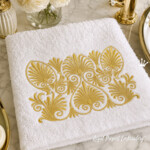
Art Nouveau Towel Ornament Machine Embroidery Design
By knowing the speed of your embroidery machine, you can find out how long it will take to embroider a design.
To use the embroidery calculator, click on the number of stitches in the product description.
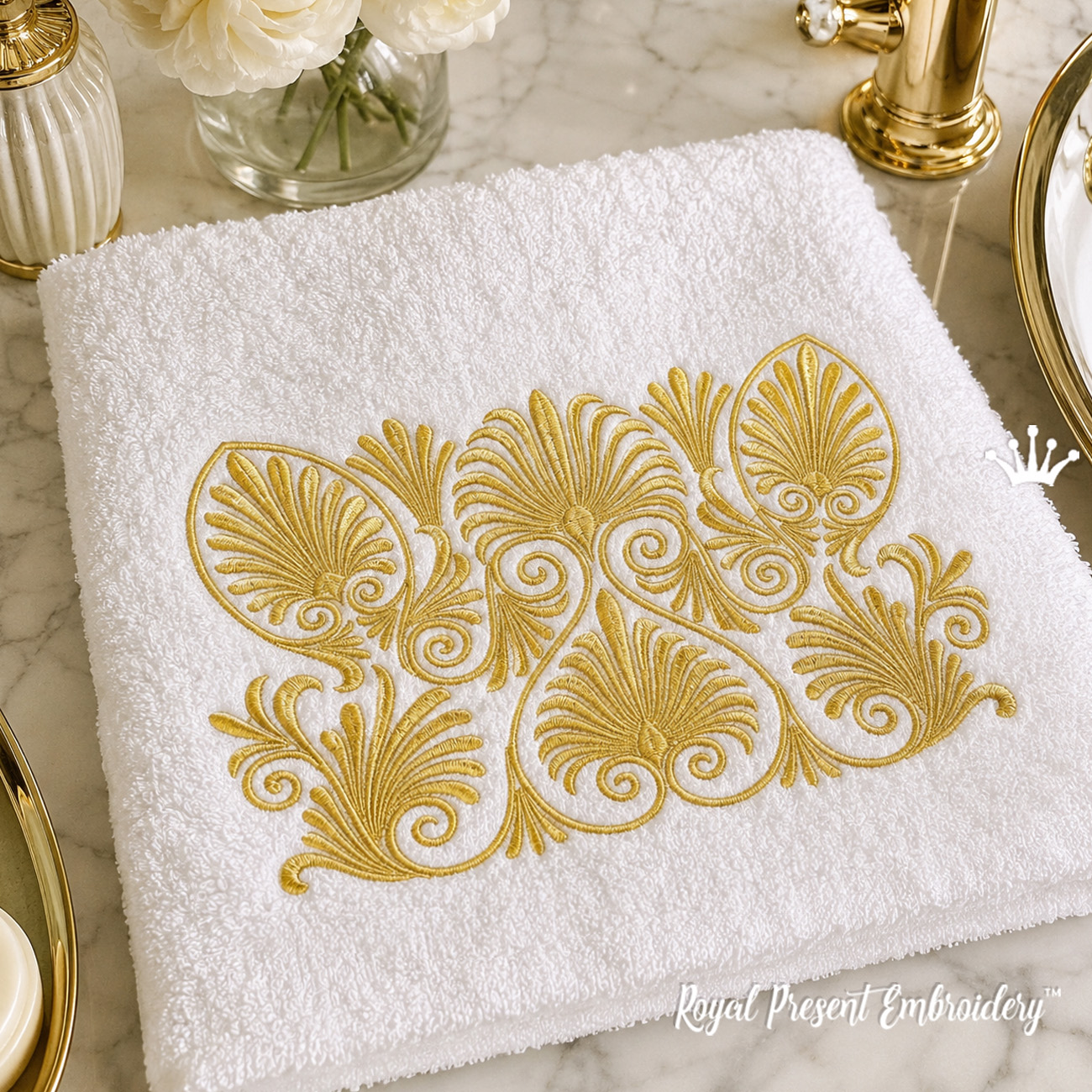
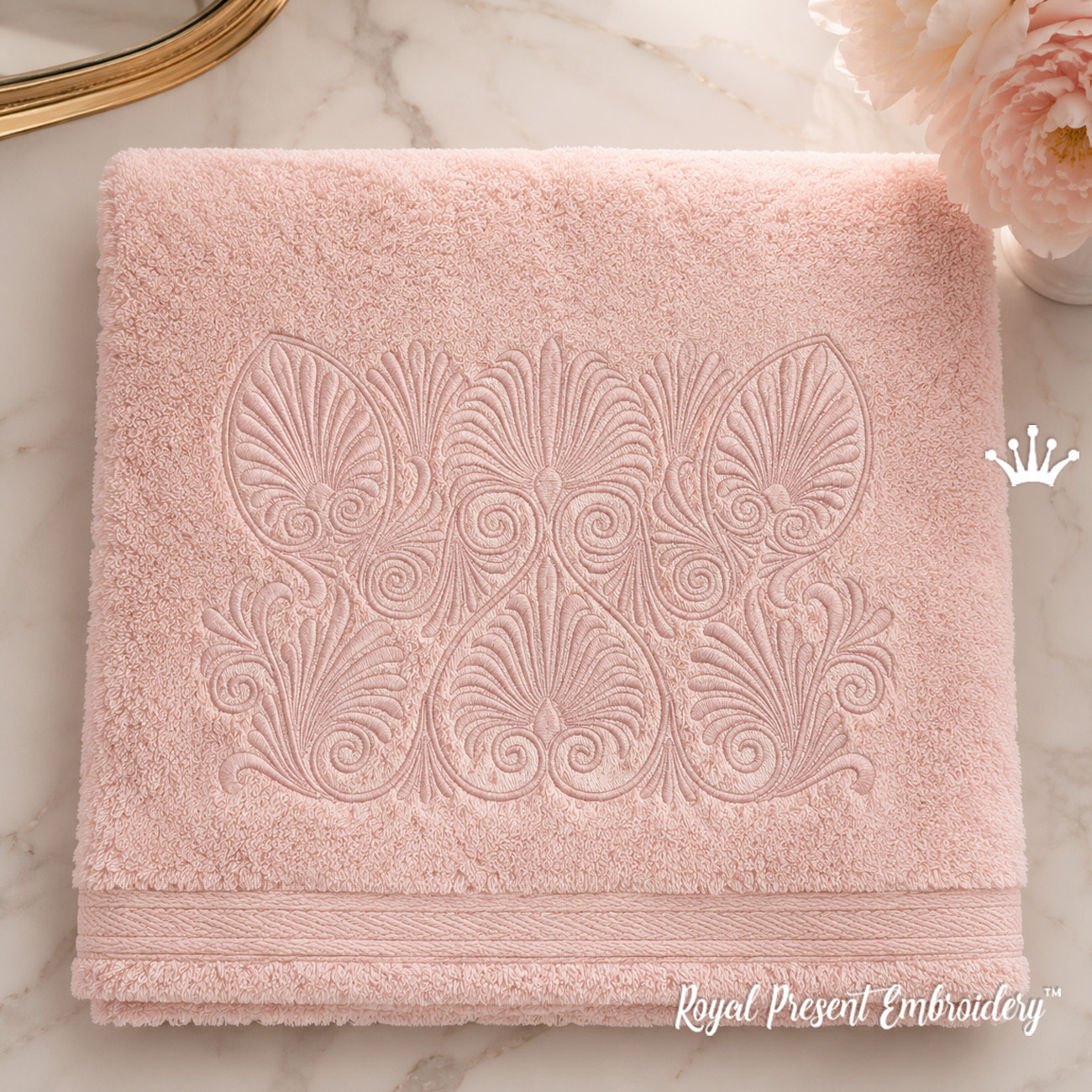
Art Nouveau Towel Ornament Machine Embroidery Design is a large vintage ornament for embroidery machines. Use this decorative motif on smooth towels, linen napkins, table runners, pillow covers and classic home textile projects.
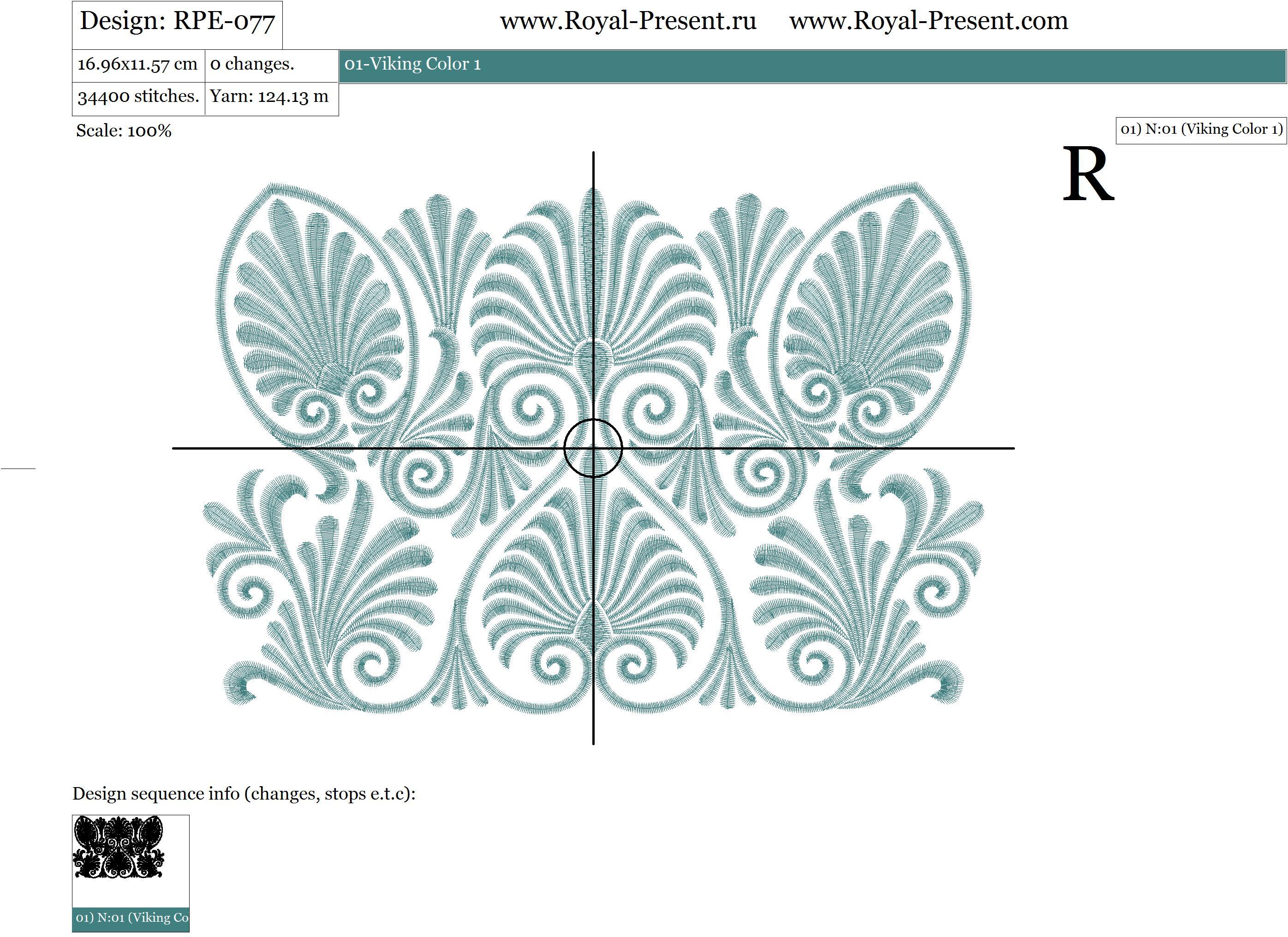
Size: 169.6x115.7 mm (6.68x4.56 "), Stitches: 34459
Formats: .dst, .jef, .pec, .vip, .hus, .pes, .exp, .sew, .dat
Art Nouveau ornament for towels and classic textile decor
Art Nouveau Towel Ornament Machine Embroidery Design is a decorative design for embroidery machines. The motif has a vintage ornamental style with symmetrical scrolls, fan-like elements and a classic early 20th-century look.
This design is best for projects where the embroidery should be a strong decorative element, not a tiny accent. Use it on smooth bath towels, kitchen towels, tea towels, linen napkins, table runners, pillow covers, textile panels and bathroom decor.
The design is large and dense: 169.6×115.7 mm and 34459 stitches. For thin fabrics, loose linen or soft towels, test stitching and proper stabilizer choice are important before embroidering the final item.
Where to use this ornament
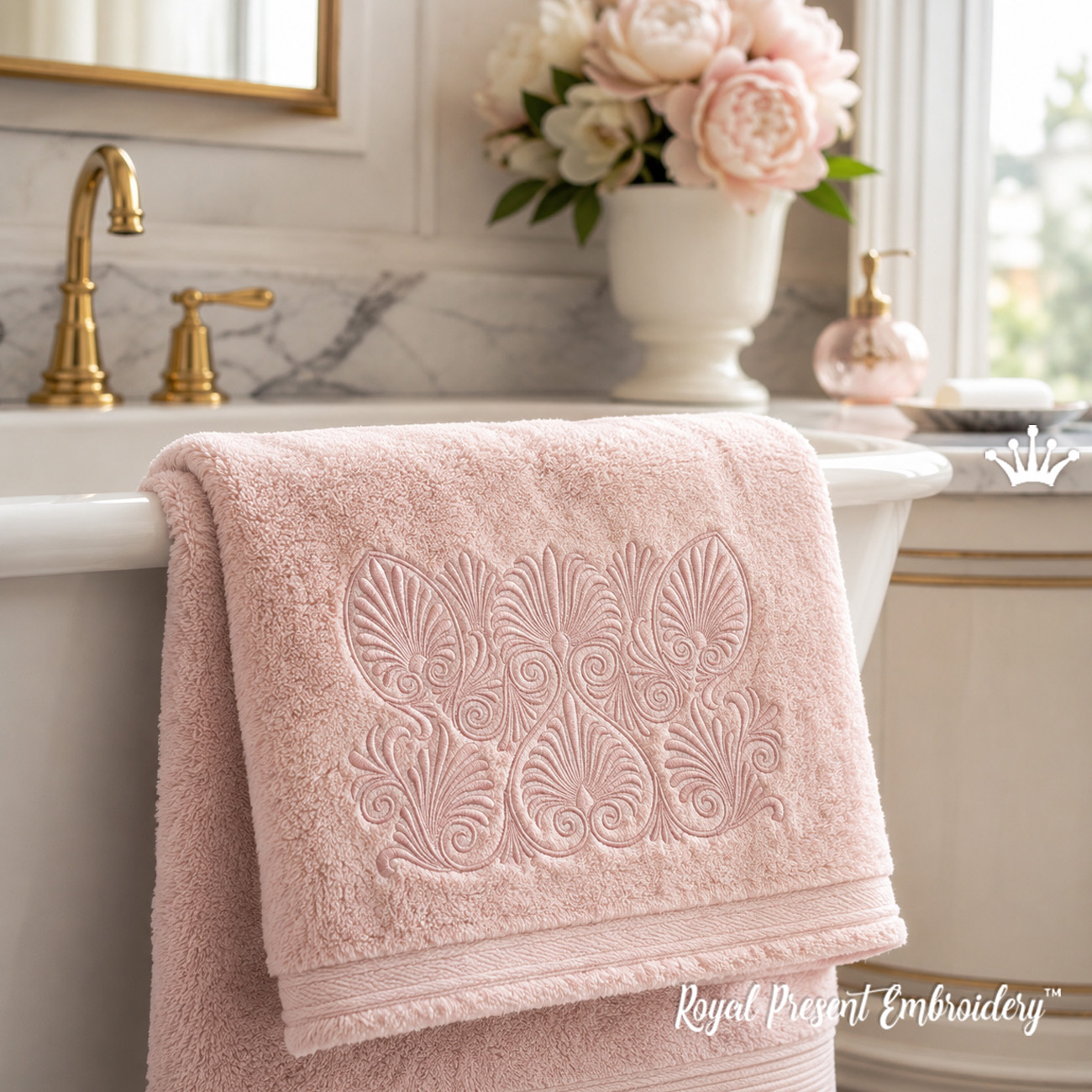
- Smooth towels: place the ornament near the lower edge of a bath towel, kitchen towel or decorative hand towel.
- Linen napkins: use it on dense linen or cotton napkins if the napkin size allows enough space around the design.
- Table runners: stitch the ornament at one end, both ends or as a central decorative element.
- Pillow covers: use it on stable decorative pillow fabric with enough support behind the embroidery.
- Textile panels: stitch the motif as a framed classic ornament or decorative insert.
- Bathroom sets: use the design for towels in a vintage, classic or Art Nouveau style.
Best fabric choices
- smooth bath towels
- smooth kitchen towels
- tea towels
- medium-weight linen
- dense cotton
- table runners
- dense napkins
- decorative pillow covers
- textile panel fabric
- stable home decor fabric
Specific stabilizer recommendations
For smooth towels around 180–240 g/m², use tear-away stabilizer around 60–80 g/m² under the fabric. Use Sulky Tear-Easy, Pellon Stitch-N-Tear or a similar medium-weight tear-away stabilizer. If the towel is soft or loose, two lighter layers, such as 40–50 g/m² + 40–50 g/m², usually work better than one very stiff layer.
For linen or cotton napkins around 150–180 g/m², use tear-away stabilizer around 50–60 g/m². The basic formula is: fabric weight divided by 3 = approximate stabilizer weight. For example, 150 g/m² fabric starts around 50 g/m² stabilizer; 180 g/m² fabric starts around 60 g/m² stabilizer.
For dense linen, table runners, pillow covers and decorative panels around 220–300 g/m², use cut-away stabilizer around 70–90 g/m². If the fabric is loose or the ornament pulls during testing, use a stronger cut-away backing such as OESD HeavyWeight CutAway, Sulky Cut-Away Soft'n Sheer or a similar firm cut-away stabilizer.
For terry towels, waffle towels and textured fabrics, add water-soluble topping on top: Sulky Solvy, Madeira Avalon Film or Madeira Avalon Ultra. Topping does not replace backing; it is added above the fabric to keep stitches from sinking into the pile and to keep scroll details clean.
For ready-made towels or hard-to-hoop areas, use self-adhesive stabilizer around 50 g/m², such as Madeira Cotton Fix or Gunold Filmoplast. Hoop the stabilizer first, remove the paper layer and place the fabric on the adhesive surface before stitching.
Needle, thread and color
For smooth towels, medium-weight linen and cotton, use a 75/11 embroidery needle. For dense linen, table runners and pillow covers, an 80/12 embroidery needle can work, but test first so the needle holes do not look too heavy near the scrolls.
This ornament works especially well as one-color embroidery: white on white, beige on linen, gray on white, gold on cream or black on a light towel. For a classic towel or table linen look, use 40 wt embroidery thread. For a softer appearance, you can test 60 wt thread, but only if your machine handles the dense sections cleanly.
For towels and items that will be washed often, choose high-quality polyester embroidery thread because it handles repeated washing better. For decorative napkins, pillow covers or framed textile panels, rayon thread can work if the item will not be washed frequently.
How to avoid puckering
Do not stretch the fabric in the hoop. The fabric should be held flat and stable, not pulled tight like a drum. When stretched fabric relaxes after hooping, it can create waves around a dense ornament.
Test stitch this design on a similar towel or linen before using the final item. If the center or scrolls pull the fabric, strengthen the support: add a second light stabilizer layer, switch from tear-away to cut-away or choose a more stable fabric.
Leave enough distance from towel hems and thick seams. Do not place this ornament on a bulky folded edge; a dense design near a thick hem can stitch unevenly and pull the fabric.
Useful nearby
For another classic ornamental style, see Art Nouveau Machine Embroidery Design. For more similar motifs, browse Classical Machine Embroidery Designs.
Before stitching a dense ornament, read Perfecting Stitch Density, Fabric, and Stabilizer Balance. If you need help choosing stabilizer types, see Choosing stabilizers for machine embroidery.
Before stitching
Check the design size, hoop area, fabric weight, stabilizer, needle, thread and exact placement before stitching the final item. For towels, linen, table runners and pillow covers, test stitch the design on similar material first.
FAQ
What stabilizer should I use for a smooth towel?
For a smooth towel around 180–240 g/m², use tear-away stabilizer around 60–80 g/m² under the fabric. Sulky Tear-Easy, Pellon Stitch-N-Tear or a similar medium-weight tear-away stabilizer can work. If the towel is soft, use two lighter layers of 40–50 g/m² instead of one very stiff backing.
What should I use for terry or waffle towels?
Use tear-away stabilizer around 60–80 g/m² under the towel and add water-soluble topping on top, such as Sulky Solvy, Madeira Avalon Film or Madeira Avalon Ultra. The topping keeps the stitches from sinking into the pile, but it does not replace the backing.
How do I calculate stabilizer weight for linen?
Use the formula: fabric weight divided by 3. 150 g/m² linen starts around 50 g/m² stabilizer. 180 g/m² linen starts around 60 g/m² stabilizer. 240 g/m² linen starts around 80 g/m² stabilizer. For this dense ornament, loose linen may need a second light layer.
Tear-away or cut-away for this design?
Use tear-away stabilizer 50–80 g/m² for stable smooth towels, dense napkins and medium-weight linen. Use cut-away stabilizer 70–90 g/m² for loose linen, table runners, pillow covers or fabric that pulls during stitching.
What needle size should I use?
Use a 75/11 embroidery needle for smooth towels, cotton and medium-weight linen. For dense linen, table runners and pillow covers, 80/12 can work. If the needle holes look too heavy, go back to 75/11 and adjust the stabilizer instead.
Which thread is better for towels that will be washed often?
Use high-quality polyester embroidery thread, preferably 40 wt, for towels and frequently washed items. Rayon can be used for decorative napkins, pillow covers or framed textile panels that will not be washed often.
Can I stitch this ornament tone-on-tone?
Yes. This design works well tone-on-tone: white on white, beige on linen, gray on white or gold on cream. For tone-on-tone embroidery, choose a thread with light sheen or one half-tone darker than the fabric so the scrolls remain visible.
How far from the towel edge should I place it?
Leave at least 25–35 mm from the lower edge, seam or hem. Avoid placing the design on a bulky folded edge because the ornament is dense and may stitch unevenly on thick seams.
How can I avoid puckering around the center and scrolls?
Do not stretch the fabric in the hoop. Use stabilizer based on fabric weight, check upper thread tension and test on similar fabric. If the fabric waves after testing, add a second light stabilizer layer or switch from tear-away to 70–90 g/m² cut-away.
Is this design suitable for thin napkins?
Only after testing. The design is large and dense, so it can be too heavy for thin napkins. Use dense linen or cotton from about 150 g/m² with stabilizer around 50–60 g/m², or choose a smaller, lighter ornament for delicate fabric.
Can I use self-adhesive stabilizer?
Yes, for hard-to-hoop ready-made towels or difficult placement areas. Use Madeira Cotton Fix or Gunold Filmoplast around 50 g/m². Hoop the stabilizer, remove the paper layer, place the fabric on the adhesive surface and check that it cannot shift during stitching.
What if I cannot open the ZIP archive?
If the archive does not open on your device, use the Royal Present online unzip tool. After extracting the archive, choose the embroidery format for your machine.
Art Nouveau Towel Ornament Machine Embroidery Design
Great

 Get Sign-In Link
 Login with Google
 Login with Facebook
 Login with Amazon
 Login with Paypal