Italian Gnomes Mini Set of 4 Machine Embroidery Designs – 4 Sizes
By knowing the speed of your embroidery machine, you can find out how long it will take to embroider a design.
To use the embroidery calculator, click on the number of stitches in the product description.
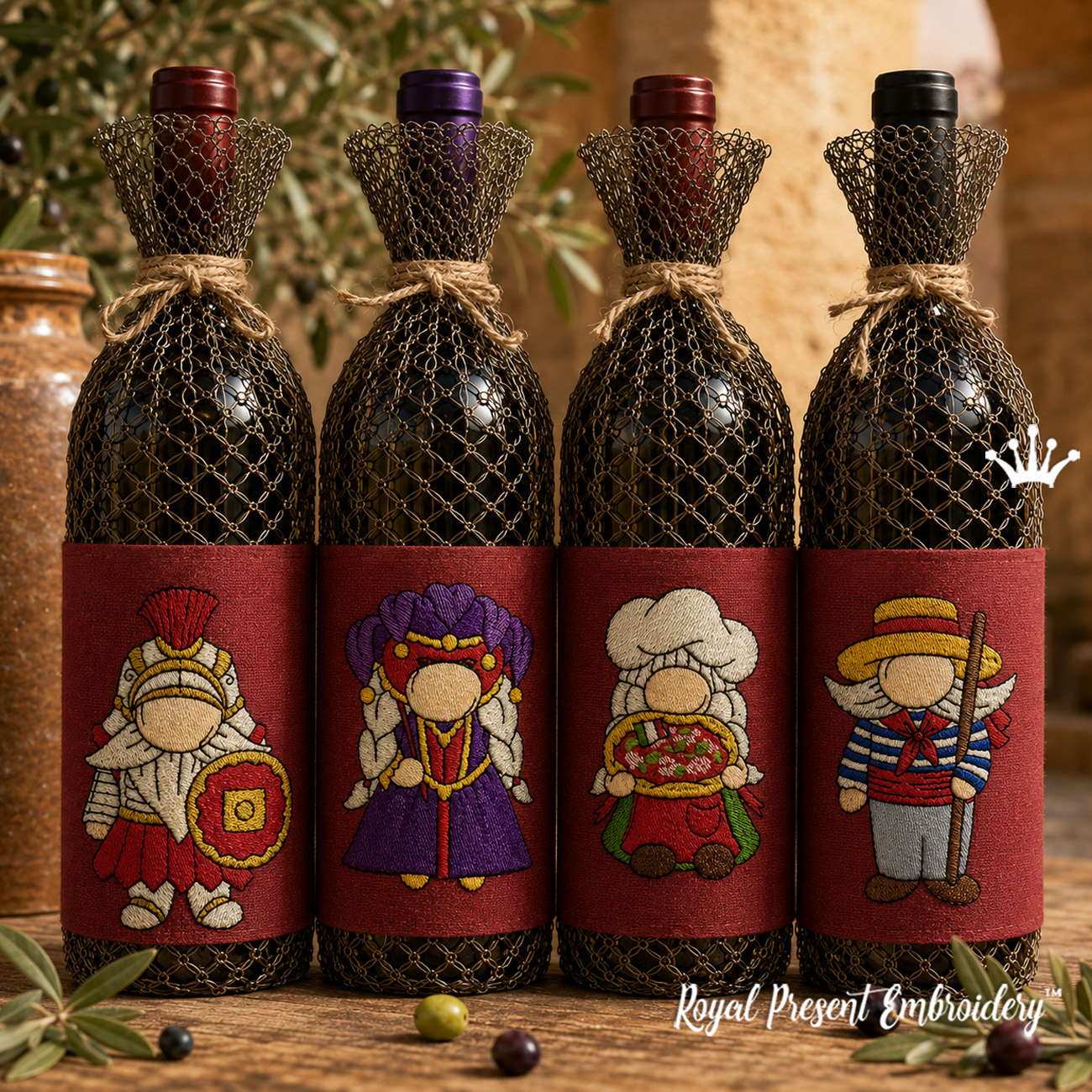
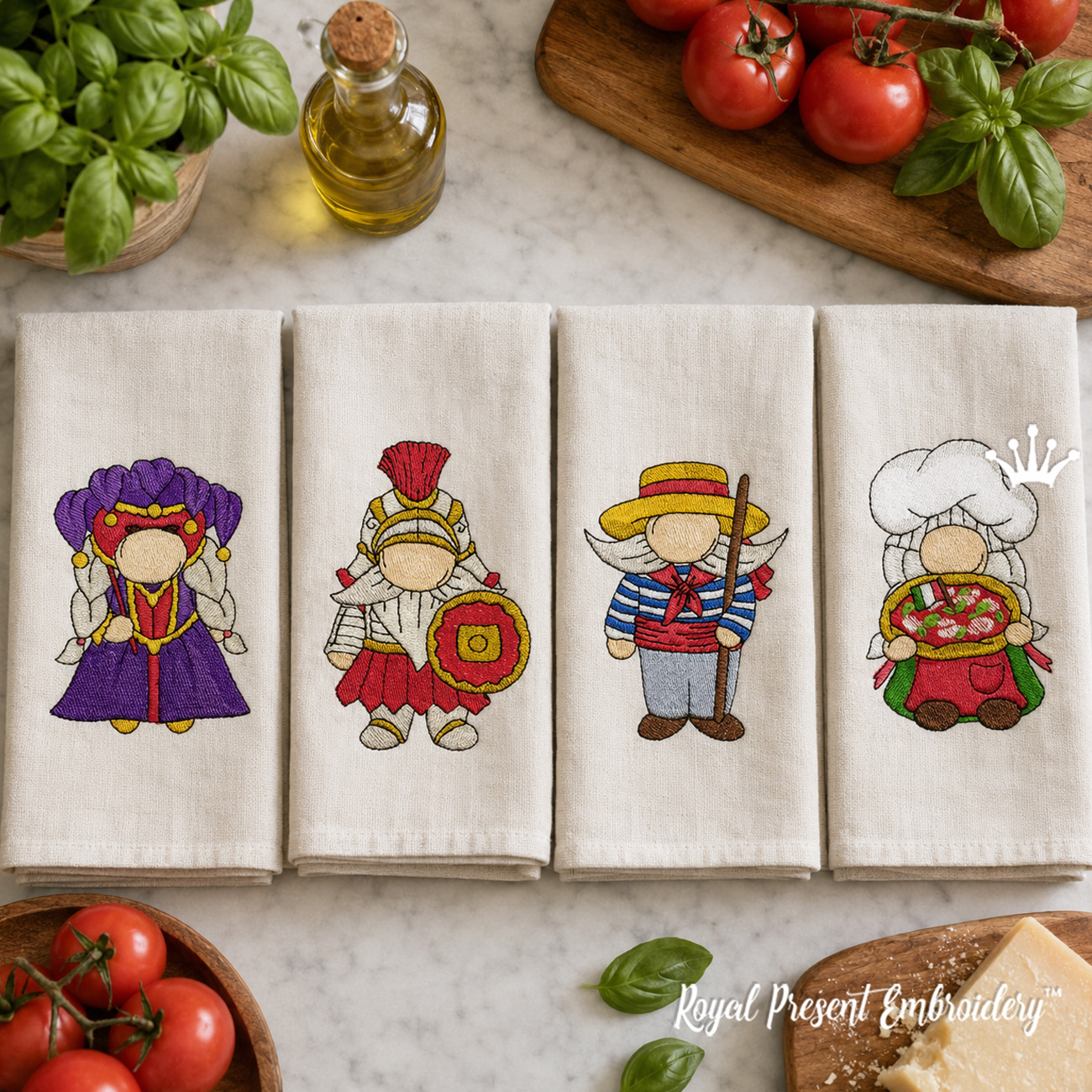
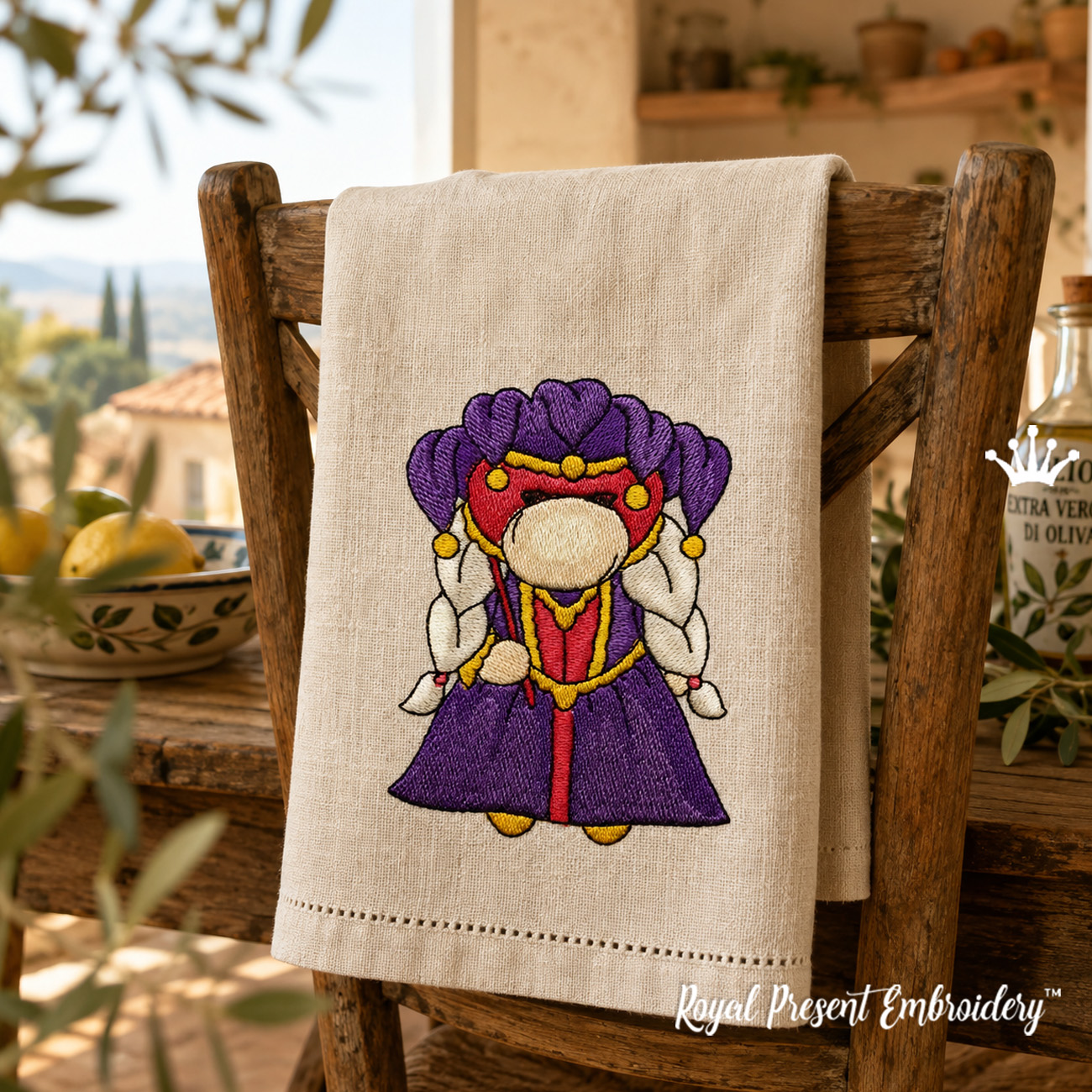
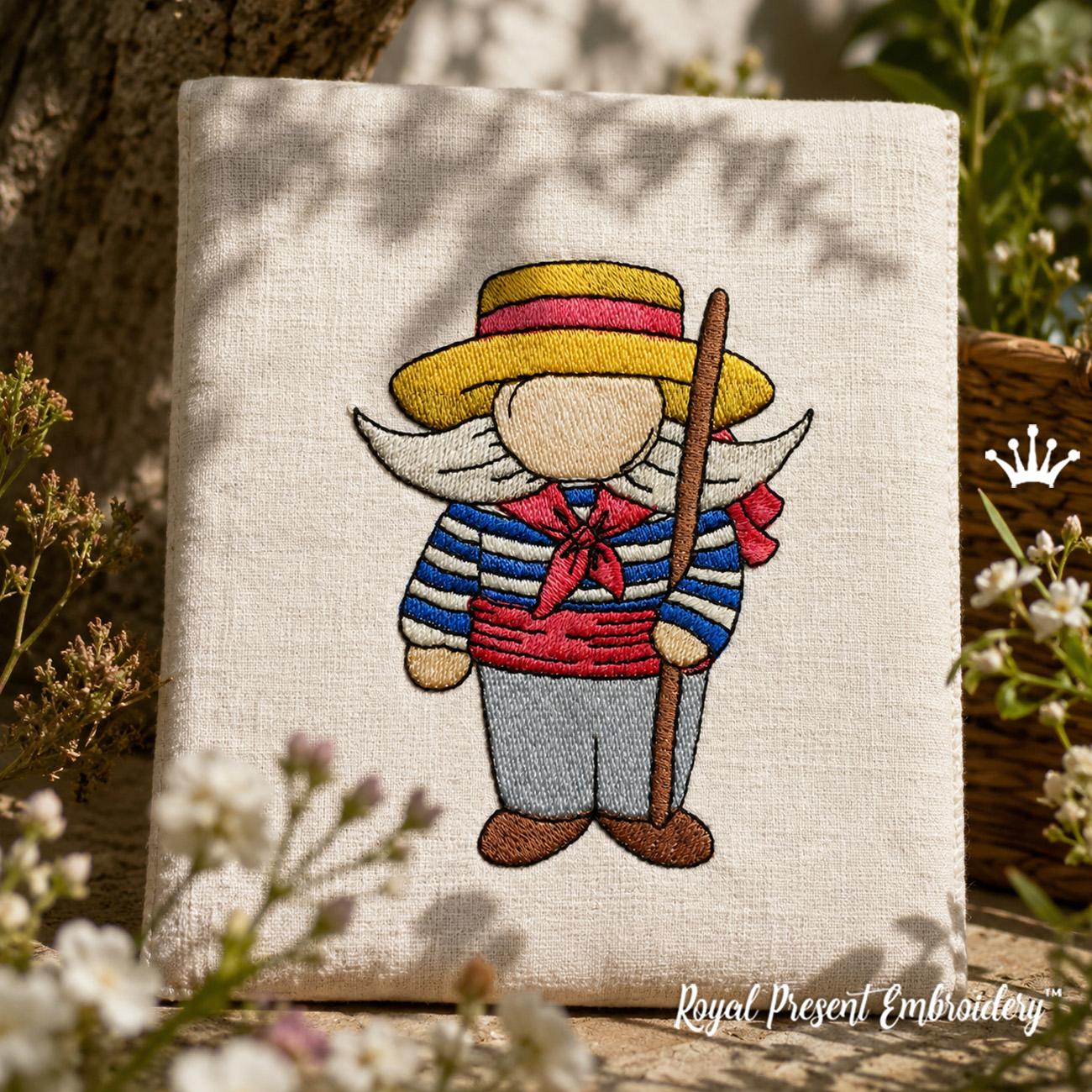
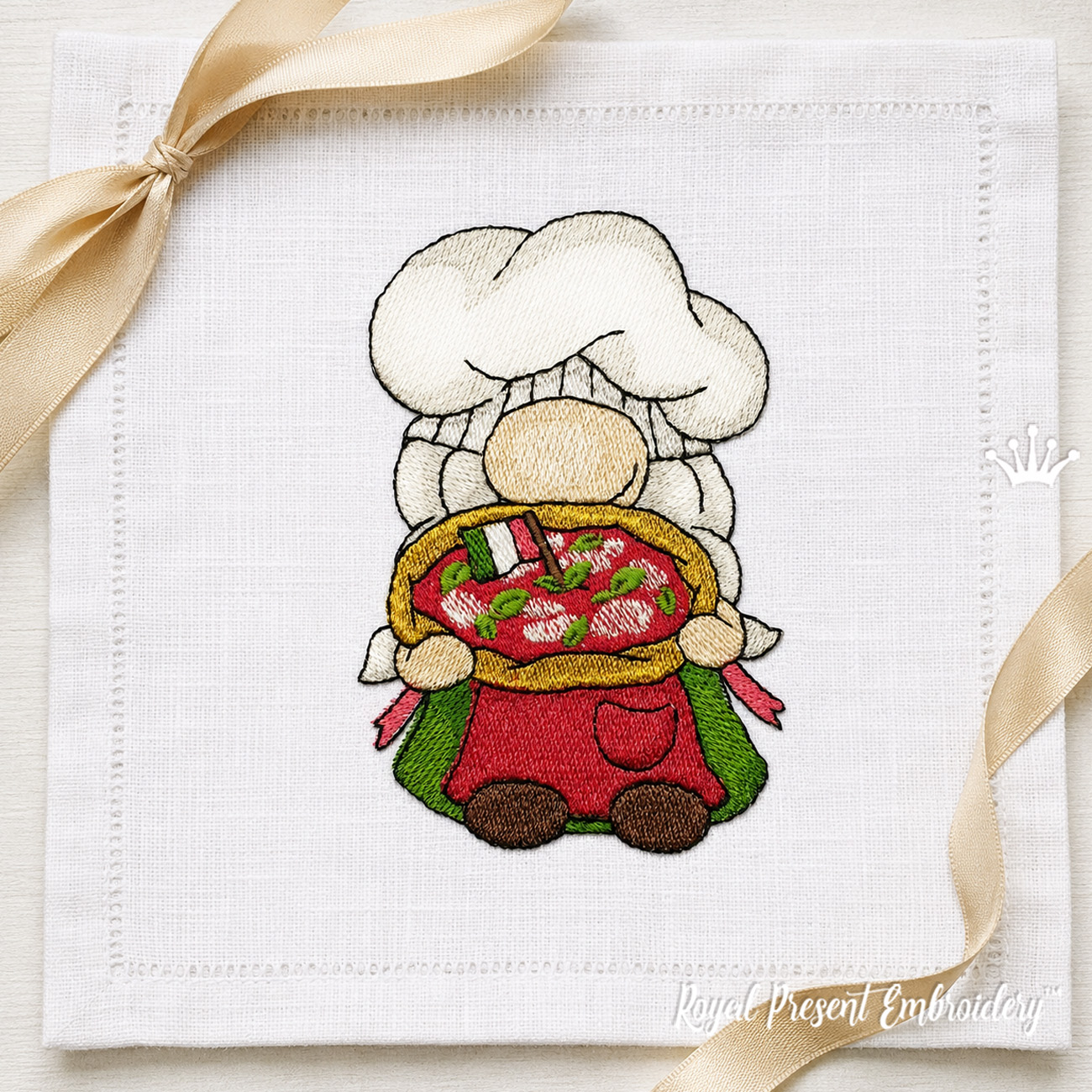
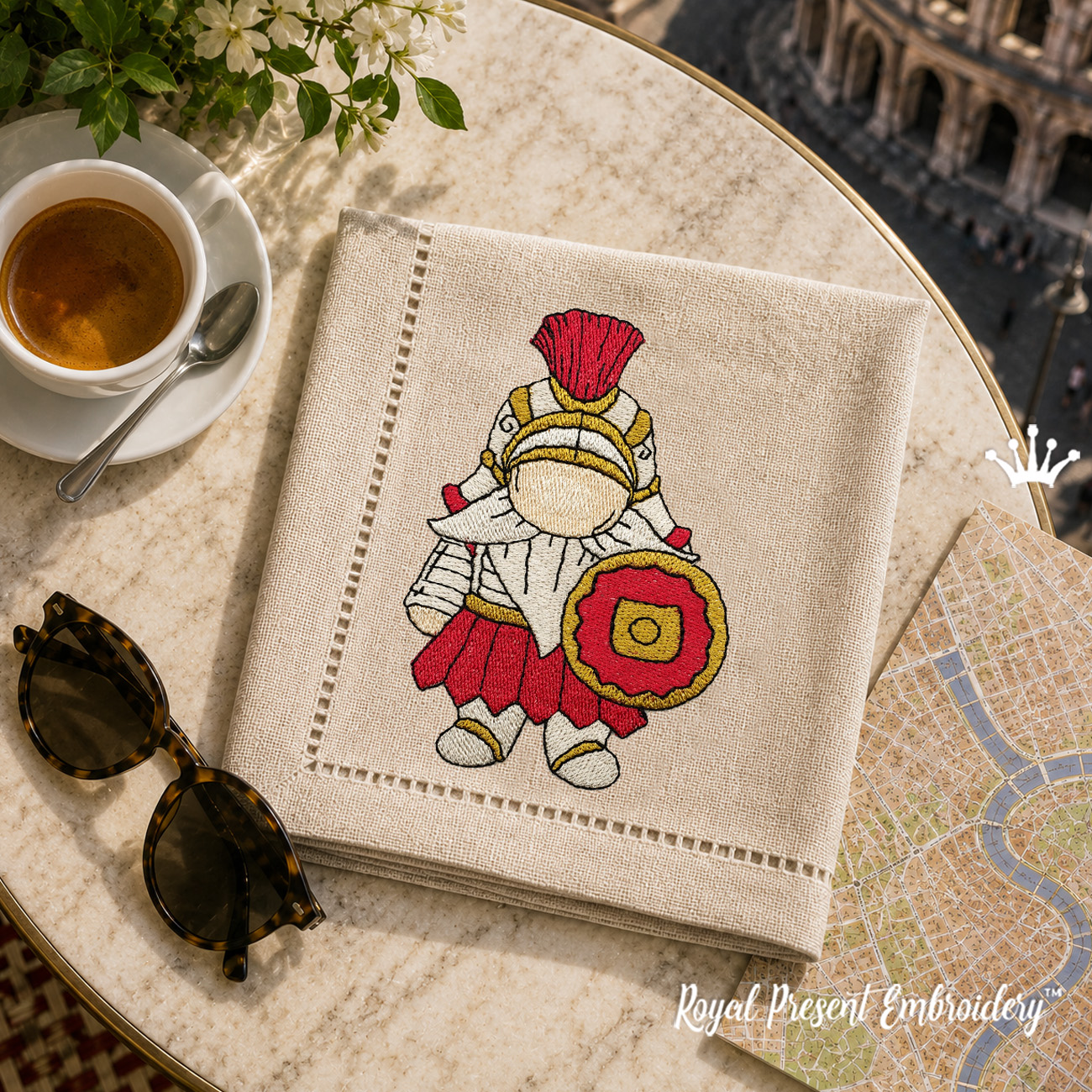
Italian Gnomes Mini Set of 4 Machine Embroidery Designs brings four recognizable Italian characters into one coordinated collection: a Roman gladiator with a plumed helmet and shield, a pizza chef holding a whole pizza, a Venetian carnival lady in an ornate purple costume and a Venice gondolier with a striped shirt, straw boater and oar.
The four independent designs can be stitched as one Italian-themed series or used separately on kitchen towels, aprons, linen napkins, wine-bottle sleeves, travel pouches, tote bags and souvenir gifts. Each character is supplied in four original sizes, giving 16 design-and-size variants in every listed machine format.
For more characters built around professions, holidays and national themes, browse the Gnome Machine Embroidery Designs collection.
Design Information
Roman Gladiator
Size: 68.4x97.9 mm (2.69x3.85"), Stitches: 13545
Size: 75.2x107.8 mm (2.96x4.24"), Stitches: 15589
Size: 82.9x118.4 mm (3.26x4.66"), Stitches: 17950
Size: 91.0x130.2 mm (3.58x5.13"), Stitches: 20706
Pizza Chef
Size: 65.4x98.0 mm (2.57x3.86"), Stitches: 15364
Size: 72.1x107.7 mm (2.84x4.24"), Stitches: 17954
Size: 79.3x118.5 mm (3.12x4.67"), Stitches: 20801
Size: 87.1x130.3 mm (3.43x5.13"), Stitches: 24111
Venice Carnival Gnome
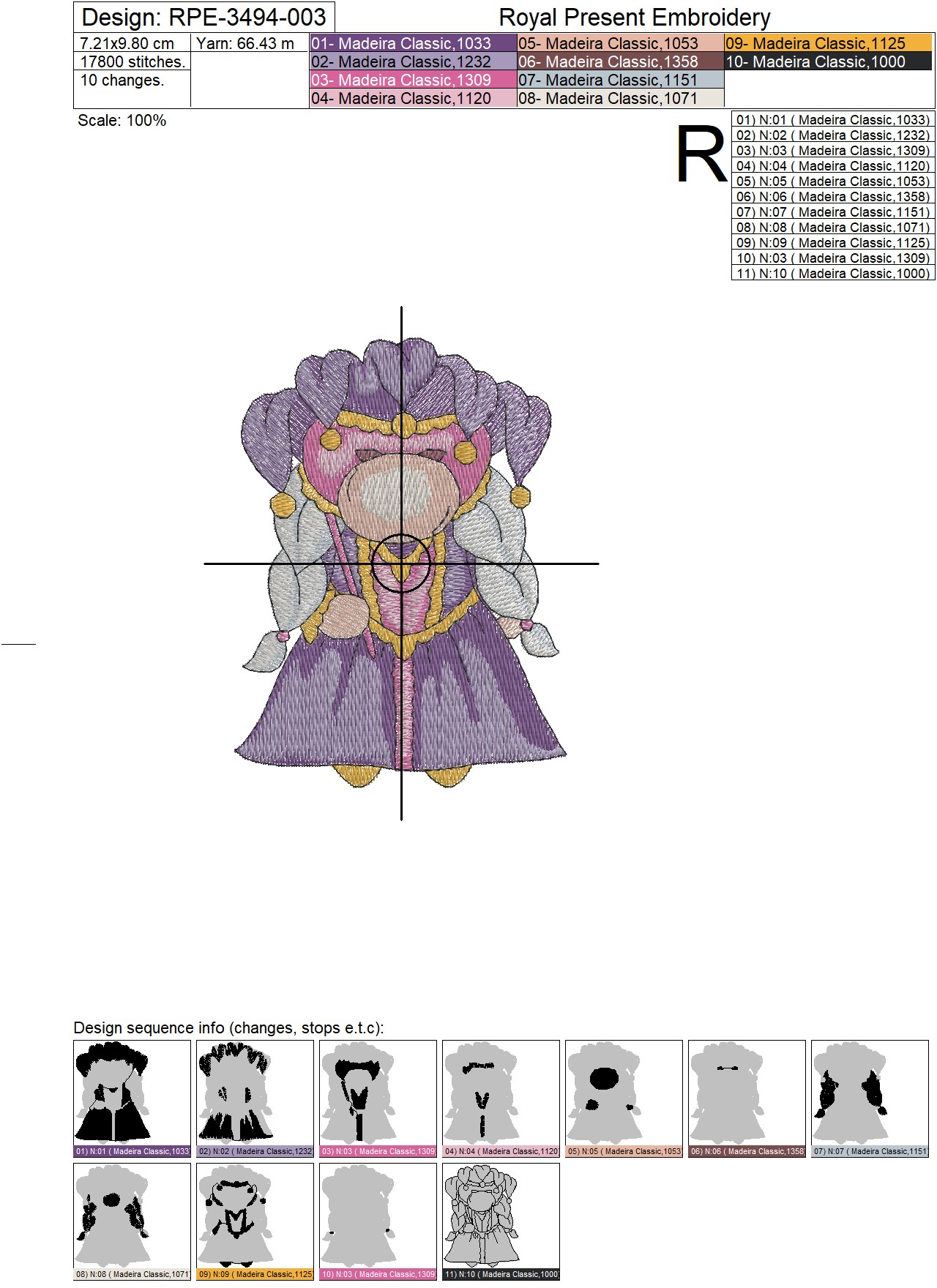
Size: 72.1x98.0 mm (2.84x3.86"), Stitches: 17784
Size: 79.3x107.8 mm (3.12x4.24"), Stitches: 20401
Size: 87.2x118.4 mm (3.43x4.66"), Stitches: 23709
Size: 96.0x130.2 mm (3.78x5.13"), Stitches: 27579
Gnome Gondolier
Size: 76.0x98.0 mm (2.99x3.86"), Stitches: 15353
Size: 83.6x107.8 mm (3.29x4.24"), Stitches: 17774
Size: 92.0x118.5 mm (3.62x4.67"), Stitches: 20412
Size: 101.2x130.3 mm (3.98x5.13"), Stitches: 23734
Formats: .dat, .dst, .exp, .hus, .jef, .jef+, .jpx, .pec, .pes, .sew, .vip, .vp3, .vp4, .xxx
Hoop and embroidery-field guide
| Original files | Compatible embroidery field | Exact limitation |
|---|---|---|
| Four first sizes | 100x100 mm (4x4") | Their heights are 97.9–98.0 mm, so the files sit close to the 100 mm limit. |
| Four second sizes and four third sizes | 120x120 mm or 100x140 mm | The third Gondolier is the widest at 92.0 mm; the third Chef and Gondolier are the tallest at 118.5 mm. |
| Largest Gladiator, Chef and Carnival Gnome | 100x140 mm | Their widths remain at or below 96.0 mm and their heights at or below 130.3 mm. |
| Largest Gondolier | 130x180 mm (5x7") | At 101.2 mm wide, this file does not fit a true 100x140 mm field even though its height is only 130.3 mm. |
Check both dimensions against the machine's permitted stitching field. The physical plastic frame may be larger than the area in which the needle is allowed to sew.
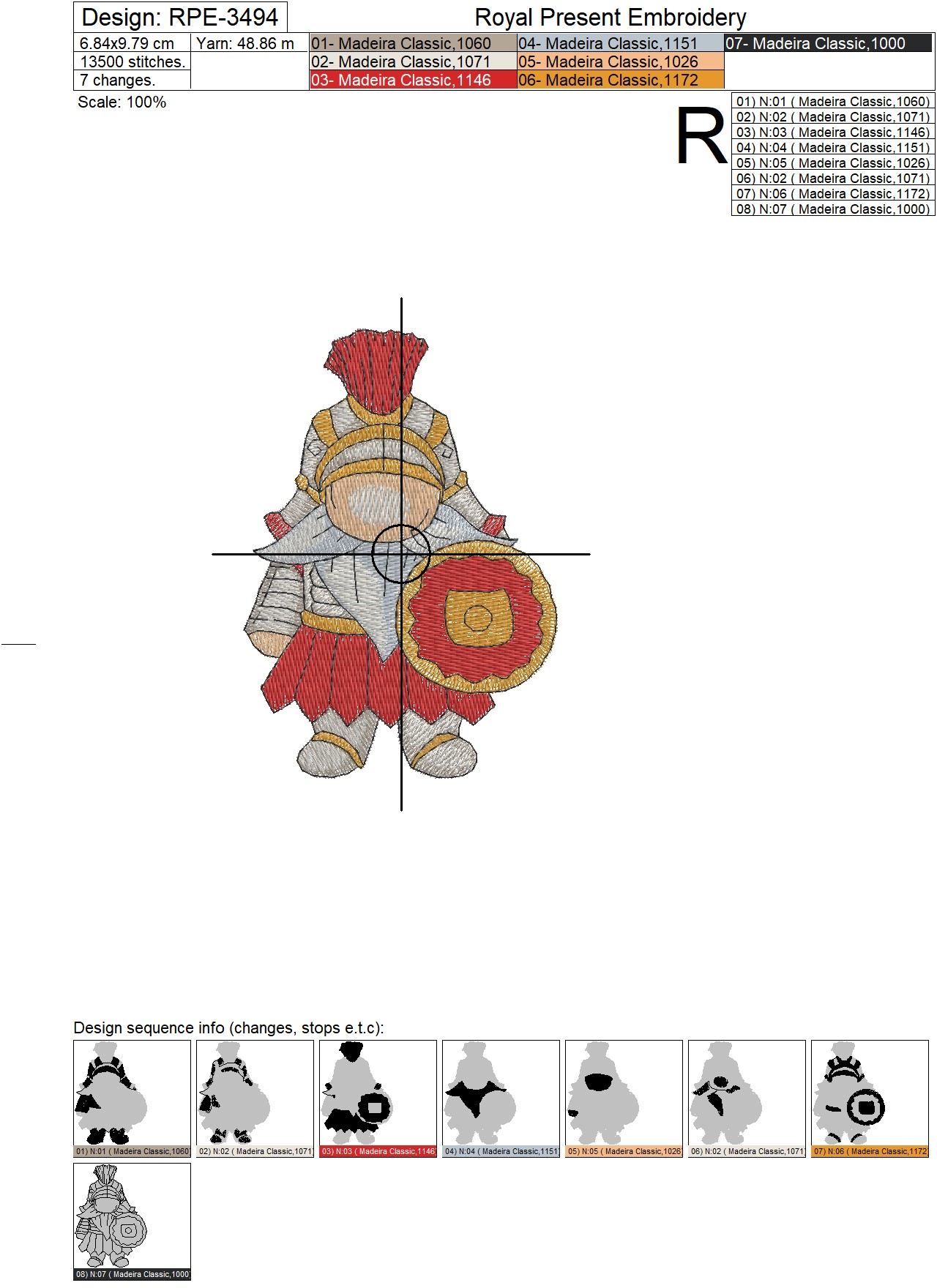
Madeira Classic Rayon 40 chart from the gallery
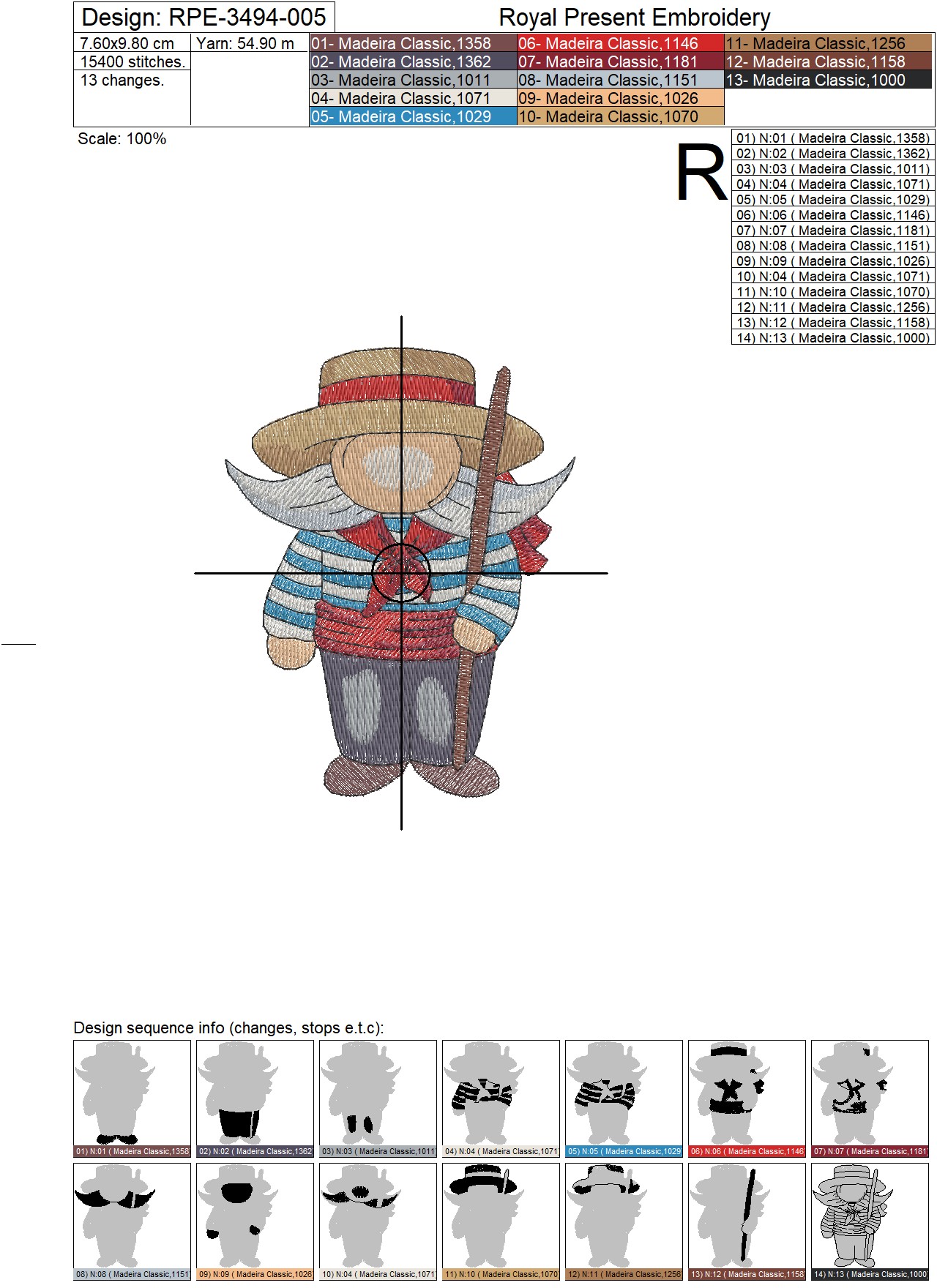
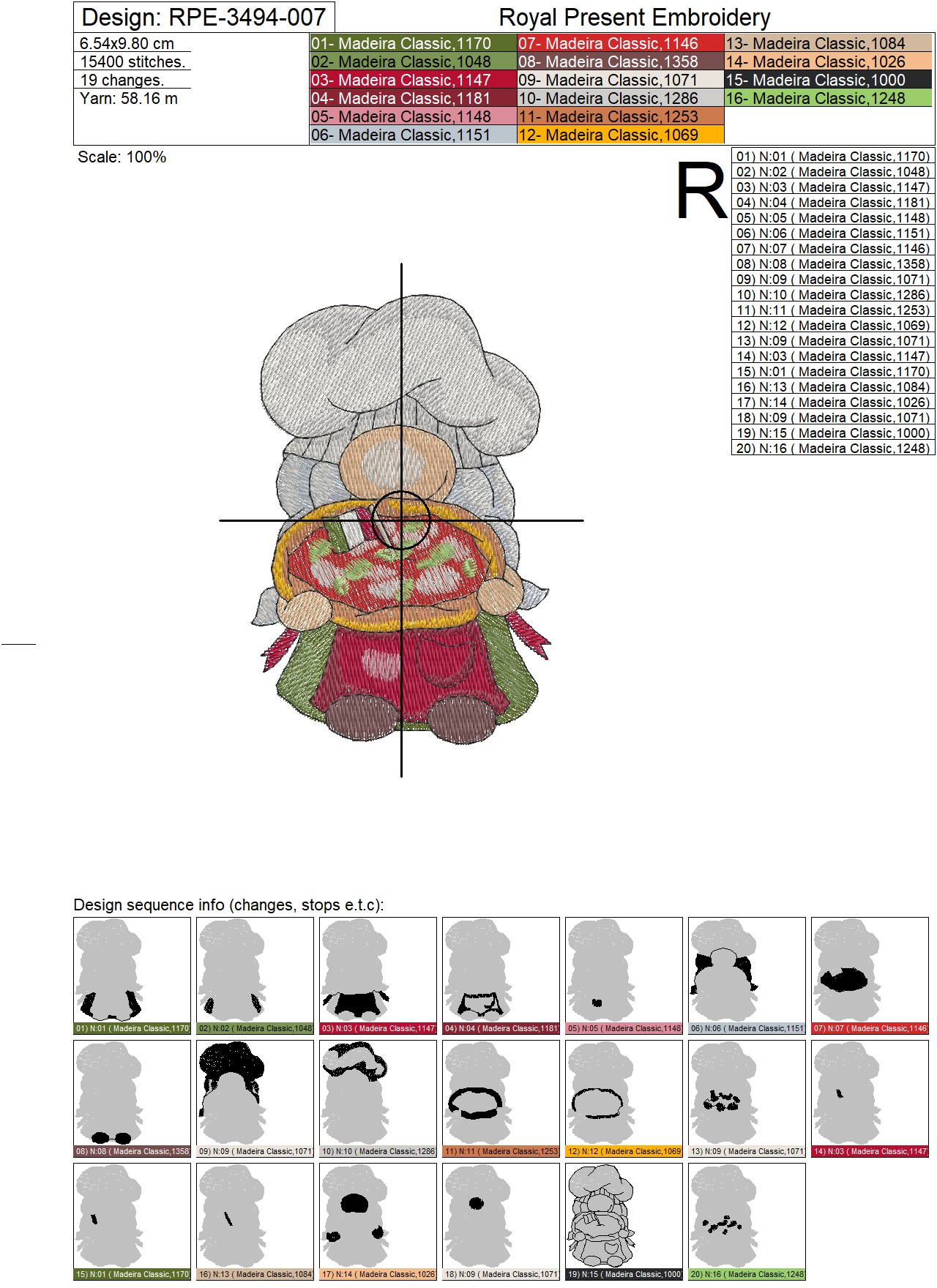
The public gallery includes readable worksheets for the four smallest files. The numbers below come from those original worksheets; they were not estimated from the stitched photographs. The squares are screen representations of the chart colors, so physical thread sheen, lighting and monitor settings will change their appearance.
| 1000 | 1011 | 1026 | |||
| 1029 | 1033 | 1048 | |||
| 1053 | 1060 | 1069 | |||
| 1070 | 1071 | 1084 | |||
| 1120 | 1125 | 1146 | |||
| 1147 | 1148 | 1151 | |||
| 1158 | 1170 | 1172 | |||
| 1181 | 1232 | 1248 | |||
| 1253 | 1256 | 1286 | |||
| 1309 | 1358 | 1362 |
Programmed color-block order shown for the 4x4 files
| Design | Madeira Classic sequence | Visible color structure |
|---|---|---|
| Roman Gladiator | 1060 → 1071 → 1146 → 1151 → 1026 → 1071 → 1172 → 1000 | armor, plume, skirt, shield, skin and final dark details |
| Pizza Chef | 1170 → 1048 → 1147 → 1181 → 1148 → 1151 → 1146 → 1358 → 1071 → 1286 → 1253 → 1069 → 1071 → 1147 → 1170 → 1084 → 1026 → 1071 → 1000 → 1248 | toque, apron, pizza crust and toppings, clothing, skin and final outline |
| Venice Carnival Gnome | 1033 → 1232 → 1309 → 1120 → 1053 → 1358 → 1151 → 1071 → 1125 → 1309 → 1000 | purple headdress and gown, pink bodice, pale sleeves, gold trim, skin and outline |
| Gnome Gondolier | 1358 → 1362 → 1011 → 1071 → 1029 → 1146 → 1181 → 1151 → 1026 → 1071 → 1070 → 1256 → 1158 → 1000 | striped shirt, red sash, trousers, straw hat, oar, skin, moustache and outline |
Follow the worksheet supplied with the exact selected file, especially when a color repeats later in the sequence. Do not use automatic color sorting: a repeated shade can return after another block to place an upper detail or secure the final structure. If another thread brand is used, the Royal Present Madeira thread converter can suggest the nearest alternative; compare the result with a physical thread chart for a color-critical project.
Fabric, stabilizer, needle and thread
| Project material | Stabilizer | Needle and thread | Design-specific point |
|---|---|---|---|
| Medium linen or cotton tea towel | Medium tear-away; use a firmer backing for the larger Carnival and Chef files on light fabric | Sharp embroidery 75/11; 40-weight polyester or rayon | Hoop on grain so the vertical bodies and long straight edges do not lean after release. |
| Terry kitchen or guest towel | Medium tear-away underneath plus thin water-soluble film on top | Embroidery 75/11 or 80/12; 40-weight polyester | Topping keeps the chef's pizza toppings, carnival trim and gondolier stripes above the loops. |
| Apron, tote or wine-bottle sleeve | Firm tear-away for stable canvas; medium cut-away for softer or repeatedly washed fabric | Sharp embroidery 75/11 or 80/12; 40-weight polyester | Embroider the flat panel before assembly and keep seams, straps and bottle-cover drawstrings outside the hoop. |
| Sweatshirt or jersey | Medium cut-away or no-show mesh; add topping only to fleece or a raised surface | Ballpoint 75/11; 40-weight polyester | Do not stretch the knit while hooping; contraction can shift the final black outline away from the filled sections. |
| Decorative cushion or framed panel | Medium tear-away on stable woven fabric or cut-away on a loose weave | Sharp embroidery 75/11; rayon No. 40 for a softer sheen | Use one continuous backing beneath all four characters when they share one composition. |
Practical tips for these four characters
- Start with a real test stitch. The small files already contain 13,545–17,784 stitches in narrow vertical shapes, so the final fabric and backing must control the density without becoming board-stiff.
- Use the smallest compatible hoop. Less unsupported fabric helps the gondolier's oar, Roman shield edge and final outlines stay registered.
- Align a set by the feet, not by the design centers. The four silhouettes have different widths and visual weights. A common floor line makes four towels or one long panel look intentional.
- Keep the original color-block order. The repeated white, red, pink, olive and gray steps are part of the construction, not accidental duplicates.
- Slow down for the small accessories and final outline. If the fabric begins to move or the upper thread frays, reduce speed to approximately 500–650 stitches per minute around the pizza toppings, carnival trim, shield, moustache and oar.
- Prefer a light or mid-tone background. Black is the unifying final detail in all four charts. On very dark fabric, stitch a test first or place the characters on a pale fabric panel so the outlines remain readable.
- Use the supplied sizes instead of automatic scaling. Shrinking these filled characters can overload the small facial, stripe and costume details; enlarging can leave satin areas too loose.
Italian-themed project ideas
- a set of four linen kitchen towels, one Italian character per towel;
- a pizza-night apron featuring the chef on the front pocket;
- wine-bottle sleeves with the Roman, Carnival and Gondolier designs;
- travel pouches, passport wallets and tote-bag panels inspired by Rome and Venice;
- four place-setting napkins for an Italian dinner;
- a long cushion or framed textile panel arranged on one common baseline;
- housewarming gifts for pizza lovers, travelers or an Italian restaurant.
The chef also pairs naturally with designs from the All Sorts Kitchen embroidery collection. For washable towels, aprons and napkins, use the care steps in the Embroidery Care: Washing, Drying and Ironing Guide.
You may also like
These four small country-themed gnomes can extend the travel and national-character collection beyond Italy.
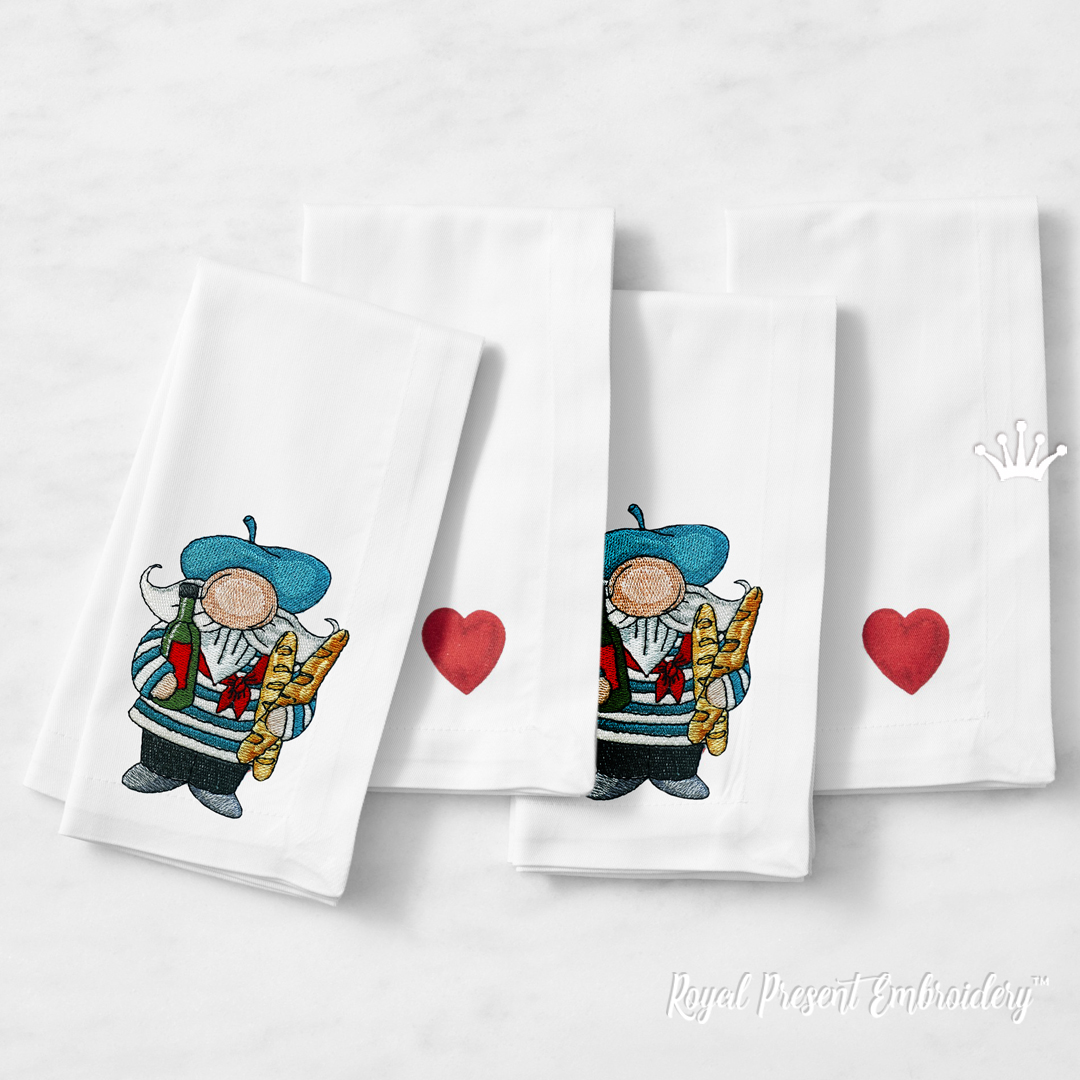 Gnome Frenchman Small Gnome Frenchman Small4 sizes |
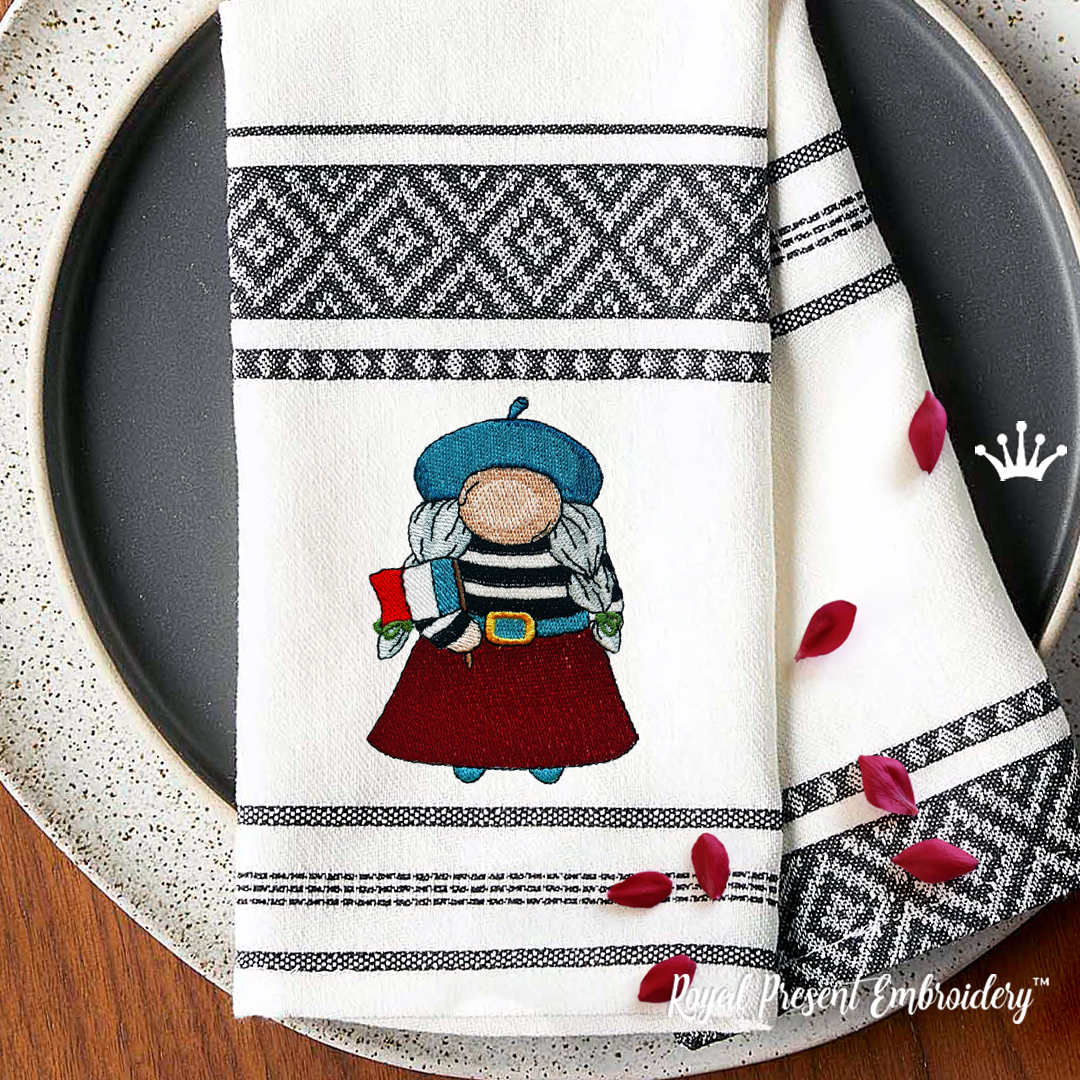 Gnome Frenchwoman with Flag Gnome Frenchwoman with Flag4 sizes |
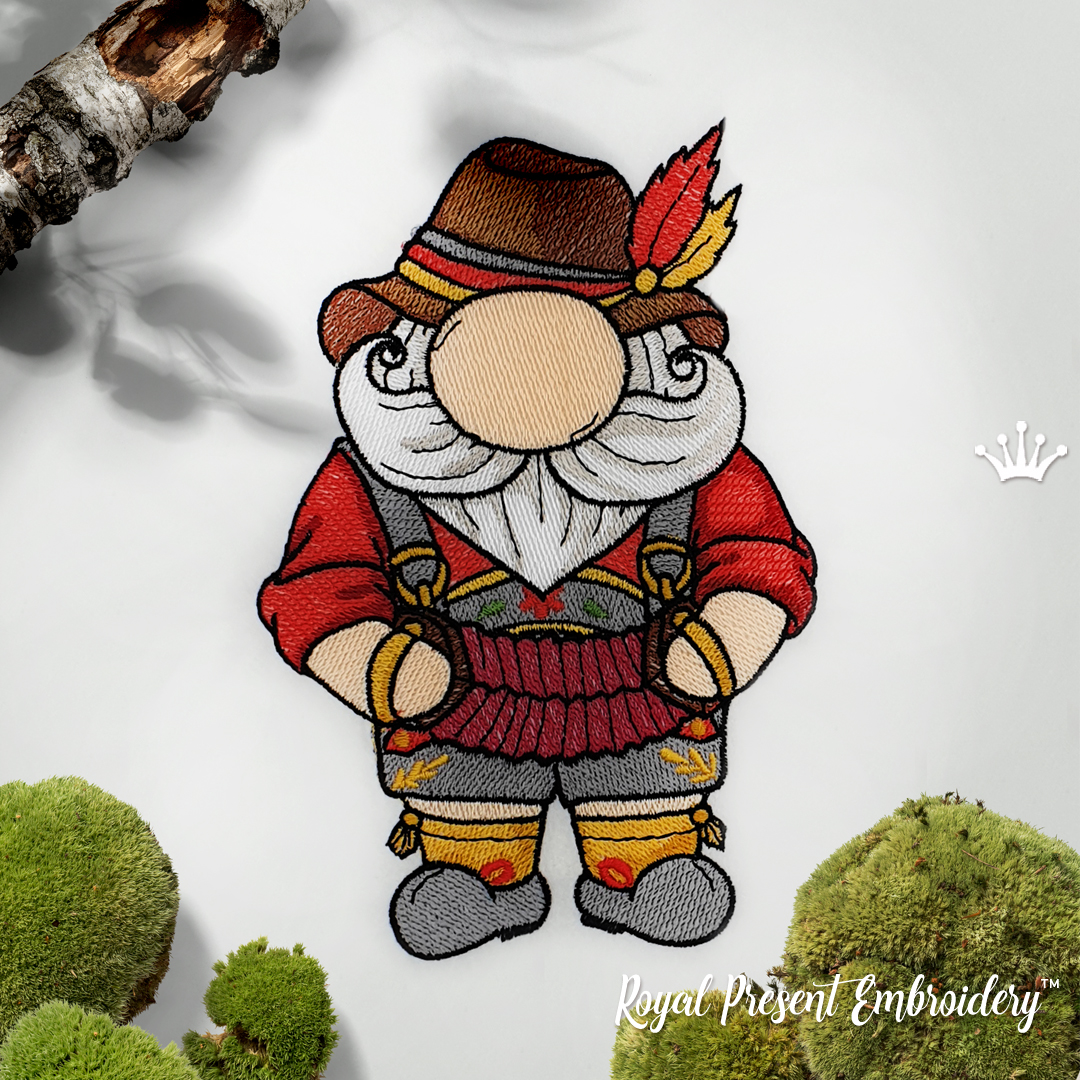 German Gnome with Accordion German Gnome with Accordion4 sizes |
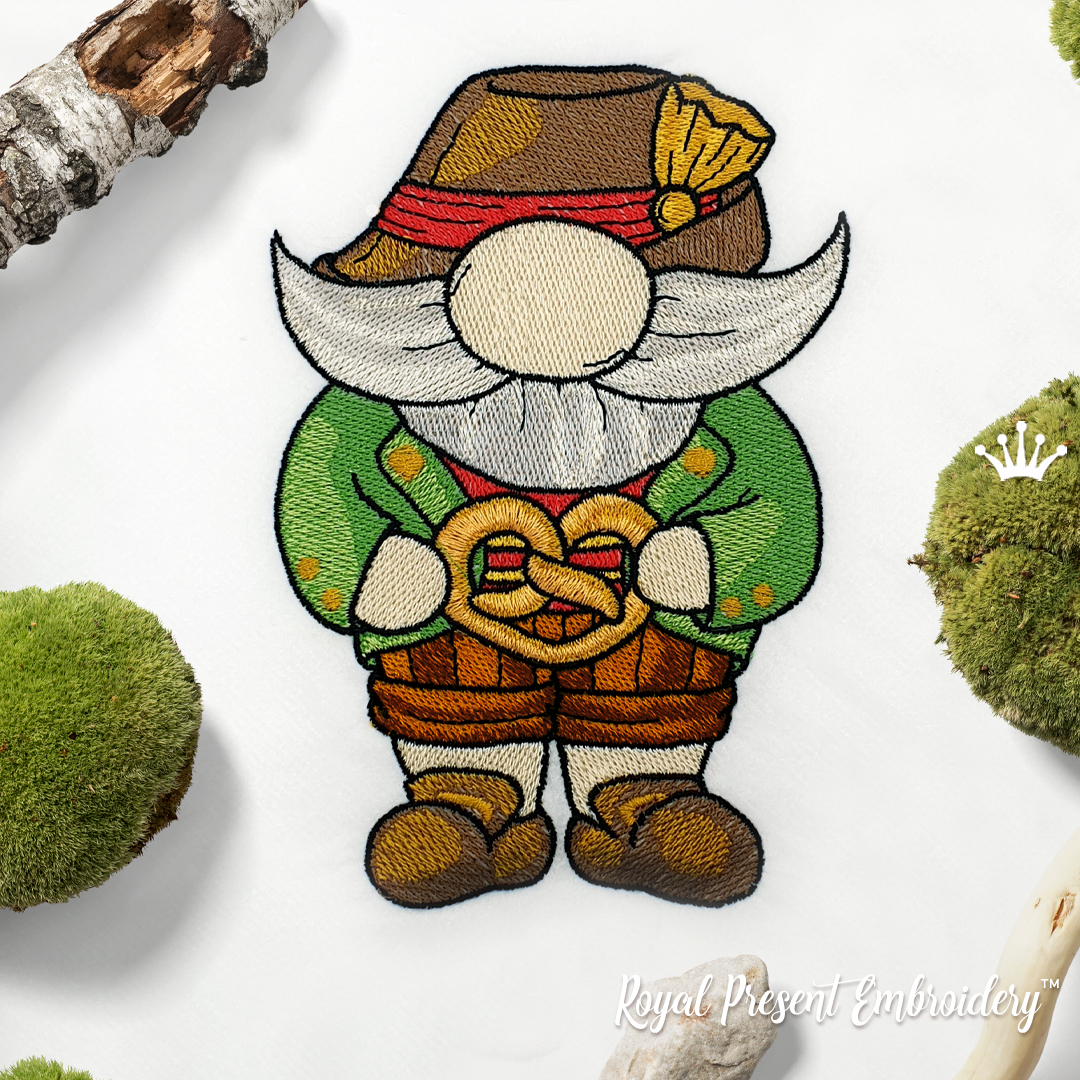 German Gnome with Pretzel German Gnome with Pretzel4 sizes |
Frequently asked questions
How many designs and sizes are included?
The set contains four independent characters: Roman Gladiator, Pizza Chef, Venice Carnival Gnome and Gnome Gondolier. Each comes in four original sizes, giving 16 design-and-size variants in every listed machine format.
Do all four designs fit a 4x4 hoop?
Only the four smallest files fit a true 100x100 mm field. Their exact heights are 97.9 or 98.0 mm, so confirm the usable field on the machine screen before stitching.
Does the largest Gondolier fit a 100x140 mm hoop?
No. Its exact published size is 101.2x130.3 mm (3.98x5.13"), so the width exceeds a 100 mm field. Use a 130x180 mm field for that file.
Which designs work best on kitchen towels?
The Pizza Chef is the most direct kitchen motif, but all four work as a coordinated Italian set. Choose a size that leaves enough clear fabric around the character and does not cross a towel band, border or thick hem.
What stabilizer should be used on a linen towel?
Use medium tear-away on stable medium-weight linen. For thin, loose or easily distorted fabric, use a firmer backing or light cut-away, especially for the larger Chef and Carnival files. Test the exact combination before stitching the finished towel.
Can the designs be used on wine-bottle sleeves?
Yes. Embroider the sleeve panel while it is flat, before the side seam, lining or drawstring is assembled. Measure the usable front panel and choose the original file that leaves room for seam allowances and the bottle's curve.
Can the Italian colors be changed?
Yes, but keep strong contrast between adjacent fills and preserve the final dark details. Follow the original stitch order even when substituting colors because repeated shades return later for construction reasons.
Why can the final outline shift away from the fills?
The usual causes are fabric movement, insufficient backing, stretched knit, an overly large hoop, a worn needle or excessive speed. Support the complete stitched area, hoop without distortion and slow down for the final details when necessary.
How should all four gnomes be arranged on one panel?
Print templates at 100% scale, establish one common floor line and balance the gaps by the outermost stitches rather than by the file centers. Use one continuous piece of backing beneath the entire four-character composition.

 Get Sign-In Link
 Login with Google
 Login with Facebook
 Login with Amazon
 Login with Paypal