Fall Pumpkin with Golden Leaves Machine Embroidery Design - 4 Sizes
By knowing the speed of your embroidery machine, you can find out how long it will take to embroider a design.
To use the embroidery calculator, click on the number of stitches in the product description.
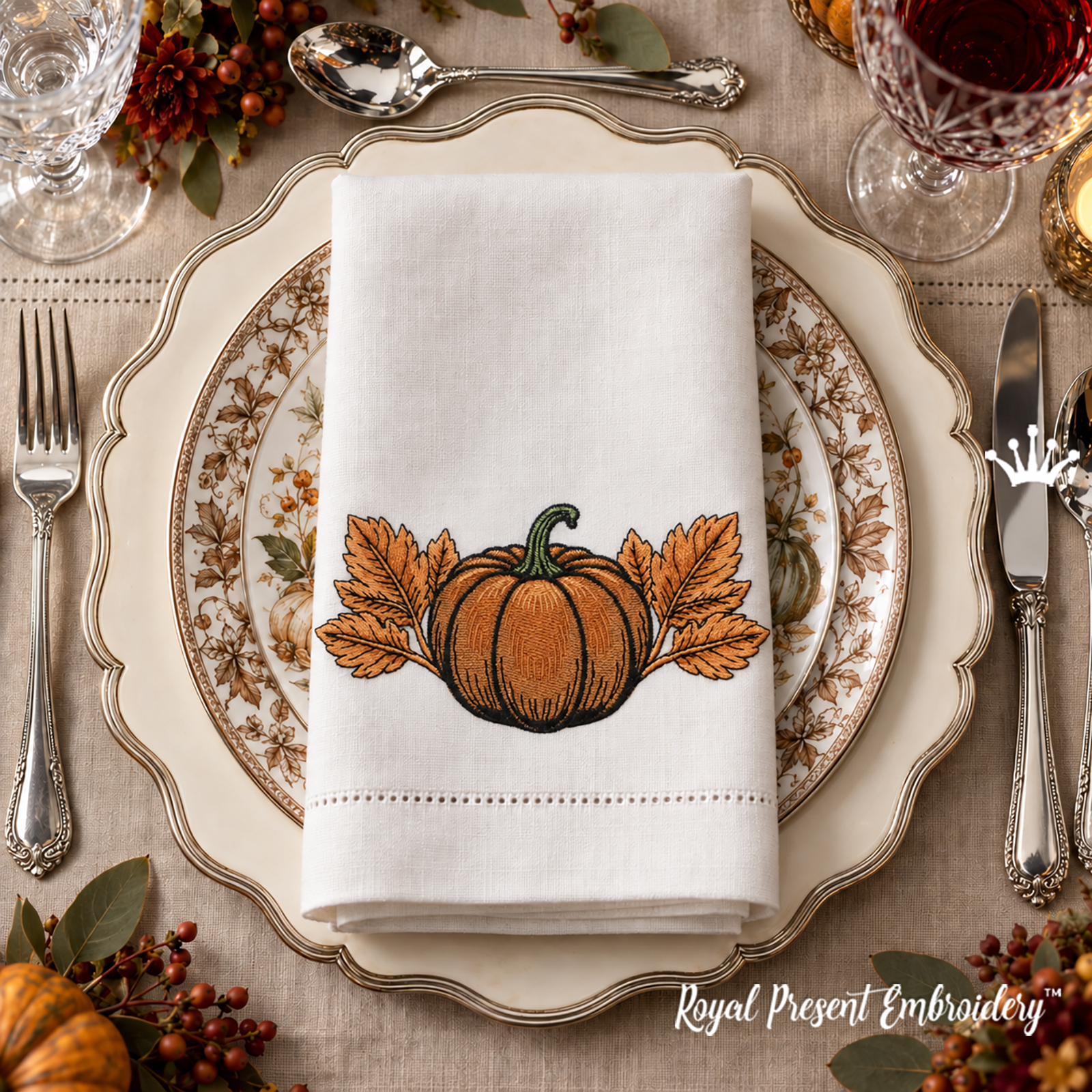
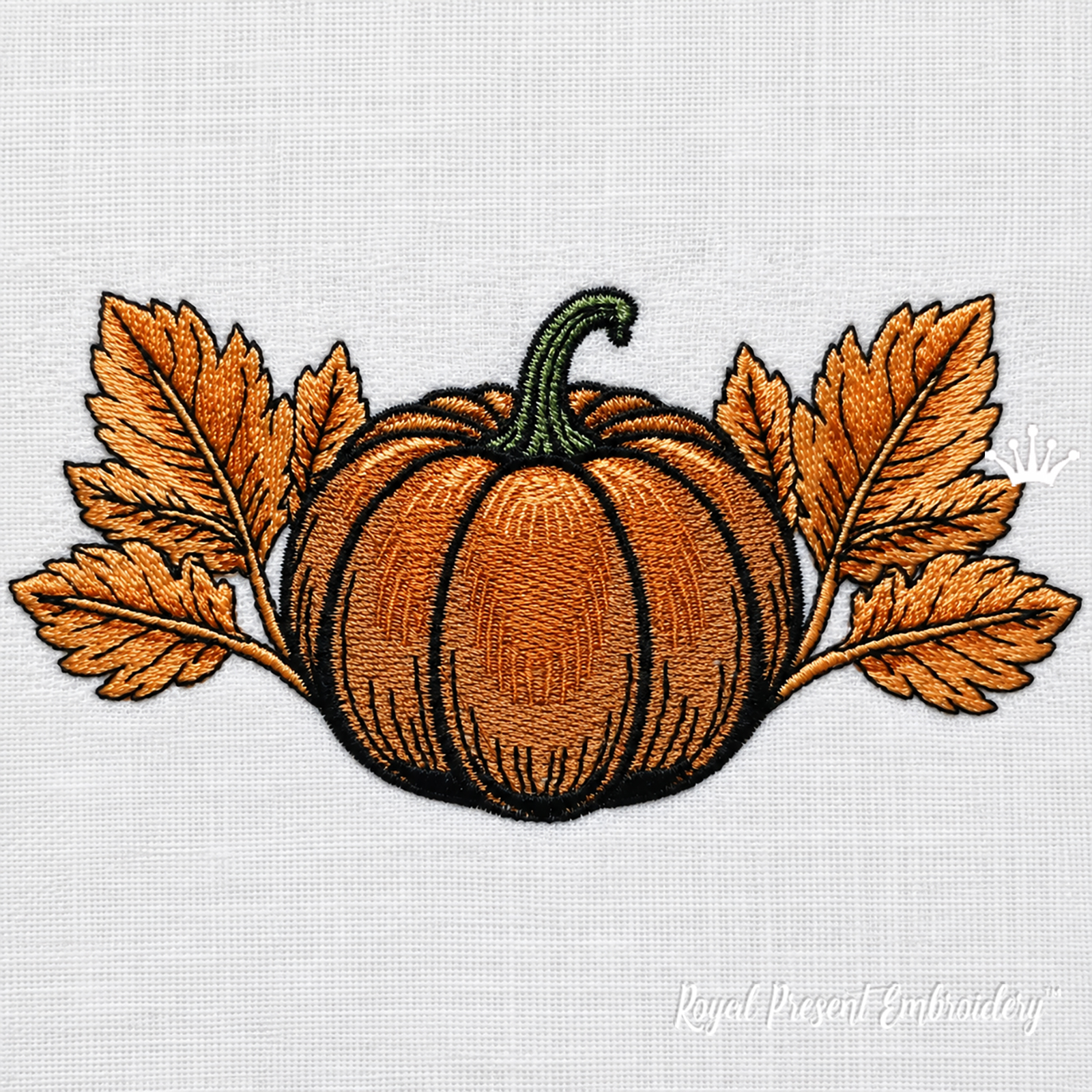
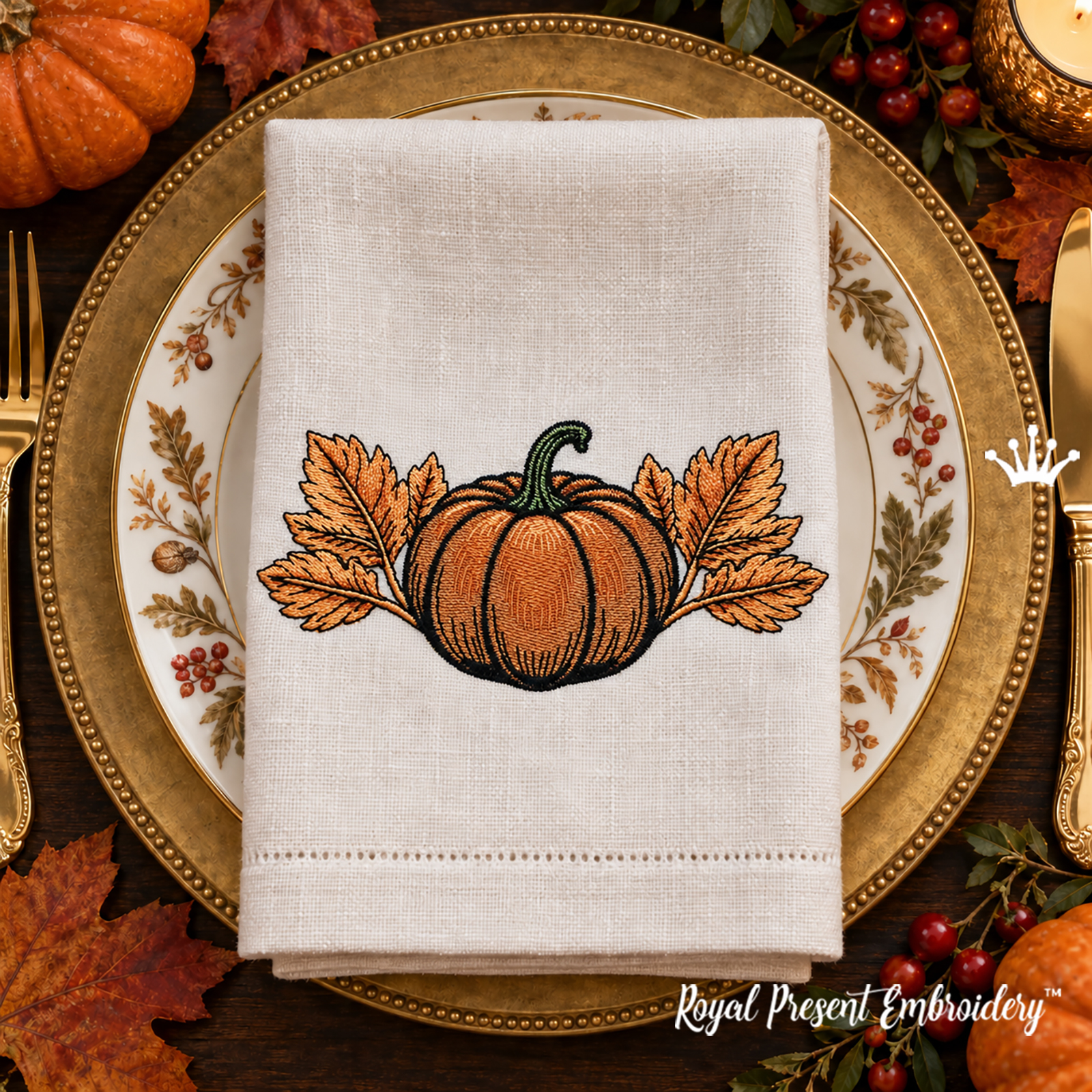
Fall Pumpkin with Golden Leaves is a digital machine embroidery design featuring a dimensional fall pumpkin with orange shading, dark graphic outlines and large golden autumn leaves. The tall botanical composition works especially well on towels, napkins, table runner ends, tote bag panels, aprons, pillows and seasonal home textiles. The download includes four prepared sizes. You receive digital files for an embroidery machine, not a finished embroidered item.
Sizes and stitch counts
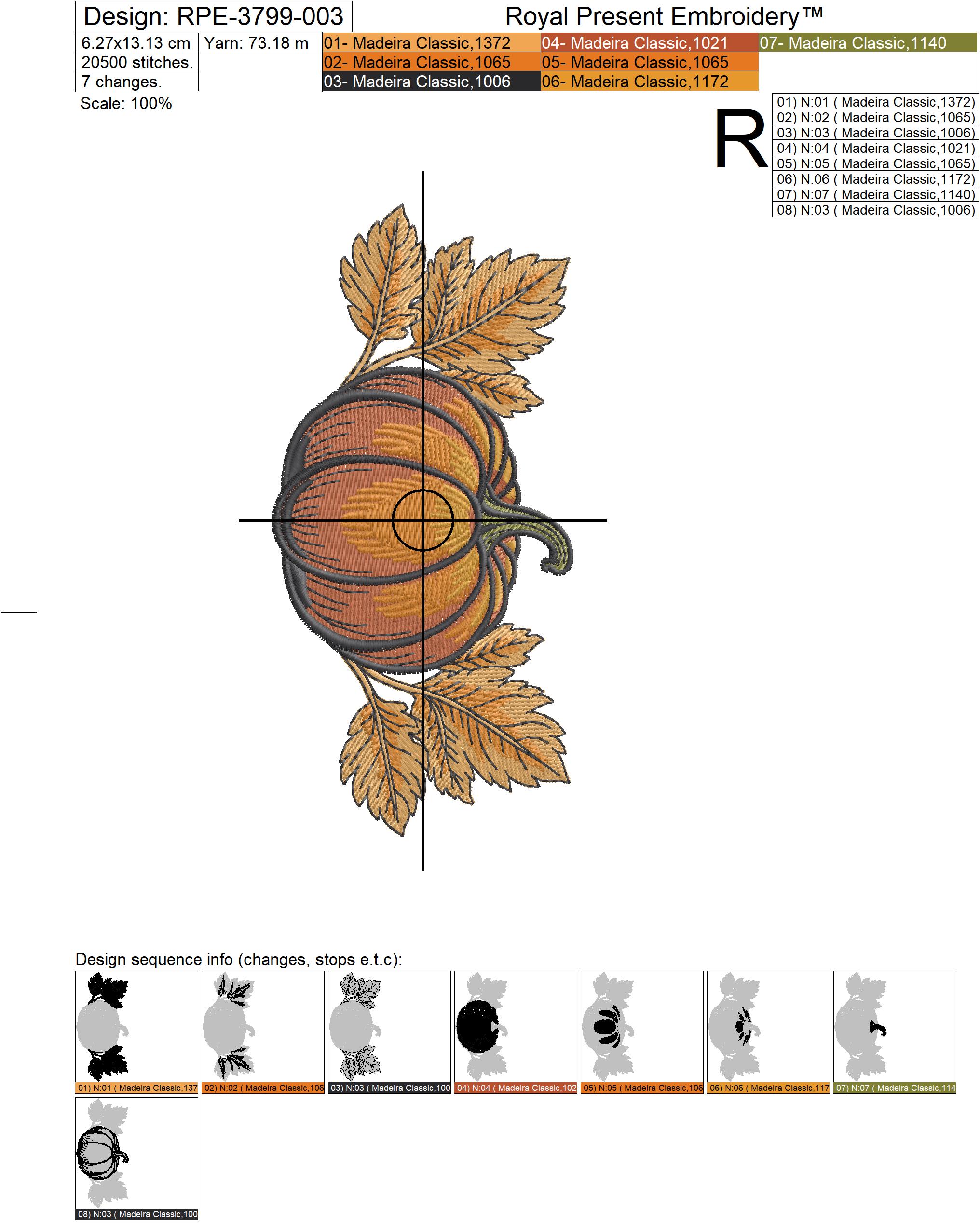
Size: 62.7x131.3 mm (2.47x5.17"), Stitches: 20500
Size: 68.9x144.7 mm (2.71x5.70"), Stitches: 23200
Size: 75.9x159.1 mm (2.99x6.26"), Stitches: 26300
Size: 83.3x174.9 mm (3.28x6.89"), Stitches: 30100
Formats: .dst, .jef, .pec, .vip, .hus, .pes, .exp, .sew, .dat, .vp3, .xxx
Thread usage from the production charts
62.7x131.3 mm — 73.18 m (80.03 yd)
68.9x144.7 mm — 85.60 m (93.61 yd)
75.9x159.1 mm — 100.34 m (109.73 yd)
83.3x174.9 mm — 118.24 m (129.31 yd)
What is included
The ZIP archive includes all four prepared sizes in the listed machine formats, the design image and JPG production color charts. After downloading, unzip the archive and choose the file format supported by your embroidery machine.
This is a digital product. Fabric, thread, stabilizer, hoops and finished embroidered items are not included.
Hoop sizes
Design size 62.7x131.3 mm — hoop 100x140 mm (4x5.5")
Design size 68.9x144.7 mm — hoop 100x170 mm (4x6.69")
Design size 75.9x159.1 mm — hoop 100x170 mm (4x6.69")
Design size 83.3x174.9 mm — hoop 130x180 mm (5x7")
Madeira Classic Rayon 40 color chart
The production chart uses 7 unique Madeira Classic Rayon 40 colors. Repeated final outline stops are not duplicated below. The screen swatch is a visual guide only; use the Madeira number as the primary reference when selecting thread.
|
Madeira Classic 1372 | Main golden-ochre fill of the autumn leaves. | |
|
Madeira Classic 1065 | Orange transitions and warm accents in the leaves. | |
|
Madeira Classic 1006 | Dark leaf veins, pumpkin segment lines and final outline work. | |
|
Madeira Classic 1146 | Main warm coral-red shading in the pumpkin. | |
|
Madeira Classic 1278 | Orange fill and transitions inside the pumpkin segments. | |
|
Madeira Classic 1155 | Light copper-peach highlights on the pumpkin. | |
|
Madeira Classic 1140 | Olive-green pumpkin stem. |
If you use another thread brand, use the free Madeira Thread Exchange converter to find the closest available matches. Screen colors are not an exact substitute for a physical thread chart.
Fabric and stabilizer
This is a moderately dense design for its stitched area: about 20500–30100 stitches are distributed across roughly 82–146 cm². On stable linen, cotton, twill or gabardine, start with tear-away backing. A useful starting formula is fabric weight ÷ 3 ≈ backing weight.
For medium-weight stable fabric, OESD Medium Weight TearAway 1.5 oz is a practical starting point. For heavier linen or if the test begins to ripple around the filled pumpkin, use OESD Heavy Weight TearAway or add a second lighter tear-away layer before moving to permanent cut-away.
For a towel end, finished pocket or another hard-to-hoop area, use a pressure-sensitive tear-away such as OESD StabilStick TearAway. On terry or deep waffle fabric, add a thin water-soluble topping so the dark leaf veins and pumpkin outlines stay above the surface texture.
With standard 40-weight embroidery thread, start with a new 75/11 embroidery needle. On heavier woven or layered fabric, test 80/12. Complete a full test stitch on the actual fabric-and-stabilizer combination before embroidering the finished item.
For more stabilizer guidance, see Choosing stabilizers for machine embroidery. Part 2.
Where to embroider it
- guest towels, tea towels and kitchen towels;
- linen napkins and table runner ends;
- vertical pillow panels and tote bag sides;
- apron bibs or wide garment panels;
- fall wall hangings and Thanksgiving textile decor.
Related machine embroidery designs
Questions and answers
What should I change if only the filled pumpkin area starts puckering while the leaves stay flat?
The main stitch load is concentrated in the pumpkin fill, not in the leaves. On the next test, strengthen the support under the entire embroidery field with a heavier tear-away or a second lighter layer. Avoid adding a small patch of stabilizer only under the center halfway through the design; the edge of that extra patch can create its own ridge.
How do I keep the final dark outline registered with the orange pumpkin shading?
Hoop the fabric and backing together without stretching them and support the loose part of the project so it cannot pull on the carriage. Before Madeira 1006 begins, check the edge of the filled pumpkin. If the fabric has already developed waves or shifted in the hoop, the outline will make that movement much more visible.
How do I place this tall design straight along the edge of a towel?
Mark a long vertical baseline parallel to the finished towel edge or fabric grain, not just a center dot. Align that line with the hoop template or machine centerline. A narrow vertical motif makes a one- or two-degree tilt much easier to notice than a square design.
Why can the fine dark leaf veins look uneven on loosely woven linen?
On loose weave, the needle can deflect between fabric threads and narrow lines lose some geometry. Use a fresh 75/11 needle, stabilize the fabric firmly and reduce speed slightly on the dark detail if needed. If the linen is very open, test on a scrap first because the fabric structure itself may be the limiting factor.
Can I stitch this design on a lightweight linen napkin?
Yes, but a lightweight napkin is more sensitive to the pumpkin fill. For linen around 4–4.5 oz/yd², start near 1.5 oz/yd² tear-away and run the complete test. If the napkin edge begins pulling toward the center, increase backing support rather than increasing upper-thread tension.
How do I remove tear-away around the fine veins without stretching the fabric?
Remove the large backing sections first, tearing toward the stitched line while supporting the fabric with your other hand. Small pieces trapped between fine veins are better left in place or removed gently with tweezers. Pulling hard under the final dark outline can distort linen more than it improves the back of the embroidery.
Do I need water-soluble topping on smooth cotton or linen?
Usually not. On smooth woven cotton or firm linen, topping adds little. Use it on terry, fleece, velvet or pronounced waffle texture where the fine dark veins can sink between loops or raised cells.
Should I slow the machine for the final dark outline?
Not if the test stitches cleanly at normal speed. On firm linen, a heavy towel or a home machine, reduce speed if Madeira 1006 begins breaking, needle penetration becomes noticeably harsh or registration starts to deteriorate. Adjust speed and project support before changing thread tension in the middle of the design.

 Get Sign-In Link
 Login with Google
 Login with Facebook
 Login with Amazon
 Login with Paypal