Embroidery Hoop Sizes Explained: Why 5×7 Means 130×180 mm
Quick answer: names such as 4×4, 5×7 and 6×10 are convenient rounded hoop-size labels. They are not always exact inch measurements. For example, many Brother machines advertised with a 5×7 inch embroidery area have an official field of 130×180 mm, which converts to 5.12×7.09 inches. Therefore, a design measuring slightly more than 5 or 7 inches may still fit if its dimensions remain within 130×180 mm.
One of the most common questions from American machine embroiderers is:
“The design is 5.08 inches wide. Will it fit my 5×7 hoop?”
If the machine’s official embroidery field is 130×180 mm (5.12×7.09 in), the answer is yes. The confusion occurs because manufacturers and retailers commonly use short, rounded inch labels such as “5×7,” while embroidery design files are displayed using more exact dimensions.
The rule is simple: use the exact embroidery field specified for your machine model, preferably in millimetres, and compare it with the exact dimensions of the design. Do not reject a design only because its converted inch measurement is slightly larger than the rounded hoop name.
What does “5×7 embroidery hoop” actually mean?
For many Brother embroidery machines, the familiar 5×7 designation refers to an official maximum embroidery area of 130×180 mm.
- 130 mm ÷ 25.4 = 5.118 inches, normally displayed as 5.12 inches.
- 180 mm ÷ 25.4 = 7.087 inches, normally displayed as 7.09 inches.
Therefore:
5×7 nominal hoop class = 130×180 mm exact field = approximately 5.12×7.09 in
The inch name has been rounded for convenience. It does not mean that the field suddenly stops at exactly 5.00×7.00 inches.
For example, a design measuring 129×179 mm converts to approximately 5.08×7.05 inches. Both dimensions are slightly larger than the rounded 5×7 label, but the design still fits inside a 130×180 mm field.
Important: this does not mean that every design slightly larger than 5×7 inches will fit every machine sold as “5×7.” The exact limit depends on the machine model. Check whether your machine’s official field is 130×180 mm, 127×178 mm or another size.
Why hoop names and exact dimensions do not match perfectly
Most embroidery equipment is engineered and digitized using metric measurements. For English-speaking markets, manufacturers provide shorter inch-based labels that are easier to remember and use in product names.
The conversion rarely produces neat whole numbers:
- 100 mm equals 3.94 inches, but the field is commonly called 4×4.
- 130 mm equals 5.12 inches, while the hoop class is commonly called 5×7.
- 180 mm equals 7.09 inches.
- 200 mm equals 7.87 inches, commonly rounded to 8 inches.
- 300 mm equals 11.81 inches, commonly rounded to 12 inches.
Depending on the metric size, the exact converted value may be slightly larger or slightly smaller than the nominal inch label. A 5×7 field may be slightly larger than 5×7 inches, while a 4×4 field of 100×100 mm is actually approximately 3.94×3.94 inches.
That is why the rounded inch name should be treated as a hoop-size category, not as the precise technical limit of every machine.
Four measurements that should not be confused
| Measurement | Example | Meaning |
|---|---|---|
| Nominal hoop name | 5×7 | A convenient rounded category used by manufacturers, shops and embroiderers. |
| Official embroidery field | 130×180 mm 5.12×7.09 in |
The maximum area within which the machine can position the needle. |
| Design size | 129×179 mm 5.08×7.05 in |
The exact width and height of the embroidery file. |
| Physical frame size | Varies by manufacturer | The outside dimensions of the plastic or metal frame. These dimensions should not be used to determine whether a file fits. |

The important comparison is between the exact design size and the official embroidery field. The nominal name and outside frame dimensions are not accurate enough for compatibility decisions.
Common rounded hoop names and their exact fields
The following table shows common hoop categories used for Royal Present machine embroidery designs. Exact support still depends on the machine model.
| Common rounded label | Metric embroidery field | Exact conversion to inches |
|---|---|---|
| Approximately 3×3 | 80×80 mm | 3.15×3.15 in |
| 4×4 | 100×100 mm | 3.94×3.94 in |
| Approximately 4×6.7 | 100×170 mm | 3.94×6.69 in |
| Approximately 4×12 | 100×300 mm | 3.94×11.81 in |
| 5×7 | 130×180 mm | 5.12×7.09 in |
| 5.5×5.5 | 140×140 mm | 5.51×5.51 in |
| 5.5×7.9 or 5.5×8 | 140×200 mm | 5.51×7.87 in |
| Approximately 5.5×8.7 | 140×220 mm | 5.51×8.66 in |
| Approximately 6.3×9.4 | 160×240 mm | 6.30×9.45 in |
| 6×10 | 160×260 mm | 6.30×10.24 in |
| 7×12 | 180×300 mm | 7.09×11.81 in |
| 8×8 | 200×200 mm | 7.87×7.87 in |
| Approximately 8×10 | 200×260 mm | 7.87×10.24 in |
| 8×12 | 200×300 mm | 7.87×11.81 in |
| 8×14 | 200×360 mm | 7.87×14.17 in |
| 12×12 | 300×300 mm | 11.81×11.81 in |
Embroidery hoop size chart by machine model
The file format does not determine the hoop size. A PES, JEF, VP3, EXP or DST file may contain a design that is too large for a particular machine. Always compare the design width and height with the machine's usable embroidery field, and check whether the design will fit after a 90-degree rotation.
The chart below lists popular home and multi-needle embroidery machines, the hoops supplied as standard and the manufacturer's maximum embroidery area. Measurements refer to the usable stitching field, not the outside dimensions of the plastic frame. Specifications were checked against official manufacturer information in July 2026.
| Machine and file | Hoops supplied as standard | Maximum embroidery area |
|---|---|---|
| Brother PE545 File: PES |
10 × 10 cm 3.94 × 3.94 in, marketed as 4 × 4 in |
10 × 10 cm 3.94 × 3.94 in |
| Brother PE900 / SE2000 File: PES |
13 × 18 cm 5.12 × 7.09 in, marketed as 5 × 7 in |
13 × 18 cm 5.12 × 7.09 in |
| Baby Lock Flare BLMFL File: PES |
15.9 × 26 cm 6.25 × 10.25 in 12.7 × 17.8 cm 5 × 7 in |
15.9 × 26 cm 6.25 × 10.25 in |
| Baby Lock Pathfinder BLPF File: PES |
20.3 × 30.5 cm 8 × 12 in 12.7 × 17.8 cm 5 × 7 in |
20.3 × 30.5 cm 8 × 12 in |
| Baby Lock Venture BMVT10 File: PES or DST |
20.3 × 35.6 cm 8 × 14 in 12.7 × 17.8 cm 5 × 7 in 10.2 × 10.2 cm 4 × 4 in 3.8 × 5.7 cm 1.5 × 2.25 in |
20.3 × 35.6 cm 8 × 14 in |
| Janome Memory Craft 400E File: JEF |
20 × 20 cm 7.87 × 7.87 in 14 × 20 cm 5.51 × 7.87 in |
20 × 20 cm 7.87 × 7.87 in |
| Janome Memory Craft 500E File: JEF Popular discontinued model |
20 × 28 cm 7.87 × 11.02 in 20 × 20 cm 7.87 × 7.87 in 14 × 20 cm 5.51 × 7.87 in 14 × 14 cm 5.51 × 5.51 in |
20 × 28 cm 7.87 × 11.02 in |
| Janome Memory Craft 550E File: JEF Popular discontinued model |
20 × 36 cm 7.87 × 14.17 in 20 × 20 cm 7.87 × 7.87 in 14 × 20 cm 5.51 × 7.87 in 14 × 14 cm 5.51 × 5.51 in |
20 × 36 cm 7.87 × 14.17 in |
| Janome Memory Craft 9850 File: JEF |
17 × 20 cm 6.69 × 7.87 in 14 × 14 cm 5.51 × 5.51 in |
17 × 20 cm 6.69 × 7.87 in |
| Janome MB-7 File: JEF or DST |
M1: 24 × 20 cm 9.45 × 7.87 in M2: 12.6 × 11 cm 4.96 × 4.33 in M3: 5 × 5 cm 1.97 × 1.97 in |
23.8 × 20 cm 9.37 × 7.87 in |
| Elna eXpressive 830 File: JEF |
20 × 28 cm 7.87 × 11.02 in 20 × 20 cm 7.87 × 7.87 in 14 × 20 cm 5.51 × 7.87 in |
20 × 28 cm 7.87 × 11.02 in |
| Elna eXpressive 830L File: JEF |
20 × 36 cm 7.87 × 14.17 in 20 × 20 cm 7.87 × 7.87 in 14 × 20 cm 5.51 × 7.87 in 14 × 14 cm 5.51 × 5.51 in |
20 × 36 cm 7.87 × 14.17 in |
| bernette 70 DECO / bernette 79 File: EXP |
16 × 26 cm 6.30 × 10.24 in 12 × 18 cm 4.72 × 7.09 in 5 × 7 cm 1.97 × 2.76 in |
16 × 26 cm 6.30 × 10.24 in |
| BERNINA B 500 / B 590 File: EXP |
25.5 × 14.5 cm 10.04 × 5.71 in 13 × 10 cm 5.12 × 3.94 in |
40 × 15 cm1 15.75 × 5.91 in |
| BERNINA B 700 / B 790 PRO File: EXP |
25.5 × 14.5 cm 10.04 × 5.71 in 13 × 10 cm 5.12 × 3.94 in 7.2 × 5 cm 2.83 × 1.97 in |
40 × 21 cm1 15.75 × 8.27 in |
| Husqvarna Viking DESIGNER QUARTZ 29 File: VP3 |
17 × 10 cm 6.69 × 3.94 in 10 × 10 cm 3.94 × 3.94 in |
17 × 10 cm 6.69 × 3.94 in |
| Husqvarna Viking DESIGNER TOPAZ 65 File: VP3 |
36 × 20 cm 14.17 × 7.87 in 12 × 12 cm 4.72 × 4.72 in |
36 × 20 cm 14.17 × 7.87 in |
| PFAFF creative expect 350 File: VP3 |
17 × 10 cm 6.69 × 3.94 in 10 × 10 cm 3.94 × 3.94 in |
17 × 10 cm 6.69 × 3.94 in |
| PFAFF creative icon 2 File: VP3 |
36 × 35 cm 14.17 × 13.78 in 36 × 26 cm 14.17 × 10.24 in 26 × 20 cm 10.24 × 7.87 in 12 × 12 cm 4.72 × 4.72 in |
36 × 35 cm2 14.17 × 13.78 in |
| SINGER SE9180 File: VP3 |
17 × 10 cm 6.69 × 3.94 in |
17 × 10 cm 6.69 × 3.94 in |
1 The BERNINA maximum embroidery field is larger than the largest hoop supplied in the standard package. Reaching the full 40 × 15 cm or 40 × 21 cm field requires a compatible optional Mega or Maxi Hoop.
2 The PFAFF creative Grand Dream Hoop uses the machine's supported large-area positioning system. Use Hoop Check and precise-positioning functions before stitching a design close to the field limits.
Important: included hoops may vary by country, dealer bundle and production revision. Check the manual and the exact carton contents for your machine. Optional, magnetic, endless and multi-position hoops should not be confused with hoops supplied as standard.
Janome MB-7 note: the supplied M1 hoop is named 24 × 20 cm (9.45 × 7.87 in), but the machine's stated maximum design field is 23.8 × 20 cm (9.37 × 7.87 in).
What about the other file formats in the download?
- PEC is associated with Brother and Baby Lock, but PES is the more practical choice for the current models in this chart.
- SEW is used by older Janome-family machines. Current Janome and Elna models normally use JEF.
- HUS and VIP are legacy Husqvarna Viking and PFAFF-family formats. Current models in this chart normally use VP3.
- XXX is a legacy format used by some older Singer and Compucon-compatible machines. The current SINGER SE9180 uses VP3.
- DST is widely supported by commercial and multi-needle machines, but the DST extension does not determine which hoop or field size the design requires.
- DAT is a less common legacy industrial format and should not be used to estimate machine or hoop compatibility.
How to check a design: a design fits only when both dimensions are within the usable embroidery field. If it does not fit in its original orientation, compare the dimensions again after a 90-degree rotation. For designs within 1–2 mm of the limit, load the file and run Trace, Corner Check or Hoop Check before stitching.
The correct formula for hoop compatibility
Let the exact design size be W×H and the machine’s official embroidery field be A×B. The file fits when:
(W ≤ A and H ≤ B) or (W ≤ B and H ≤ A)
The second part allows the design to be rotated by 90 degrees. Rotation swaps the width and height, but it does not enlarge the embroidery field.
For a machine with an official 130×180 mm field, the design fits when:
- its width is no more than 130 mm and its height is no more than 180 mm; or
- after rotation, its width is no more than 180 mm and its height is no more than 130 mm.
There is no need to subtract an invented 20 mm border from the manufacturer’s stated embroidery field. The official field already defines the area within which the machine can safely stitch.
Why measuring the hoop with a ruler does not work
The outside dimensions of a plastic or metal frame do not show the machine’s embroidery field. Even measuring the visible opening can produce the wrong conclusion because the embroidery unit may not move the needle across the entire opening.
A customer once contacted Royal Present because her machine could not display a design measuring 138×198 mm (5.43×7.80 in). She believed that she owned a 140×200 mm hoop because she had measured the frame with a ruler.
In fact, her machine supported a 130×180 mm field. The design would fit a real 140×200 mm field, but it could not fit her machine’s 130×180 mm embroidery area.
The correct information must come from:
- the embroidery machine manual;
- the official manufacturer specifications;
- the hoop-selection menu on the machine;
- the exact model number printed on the hoop or frame.
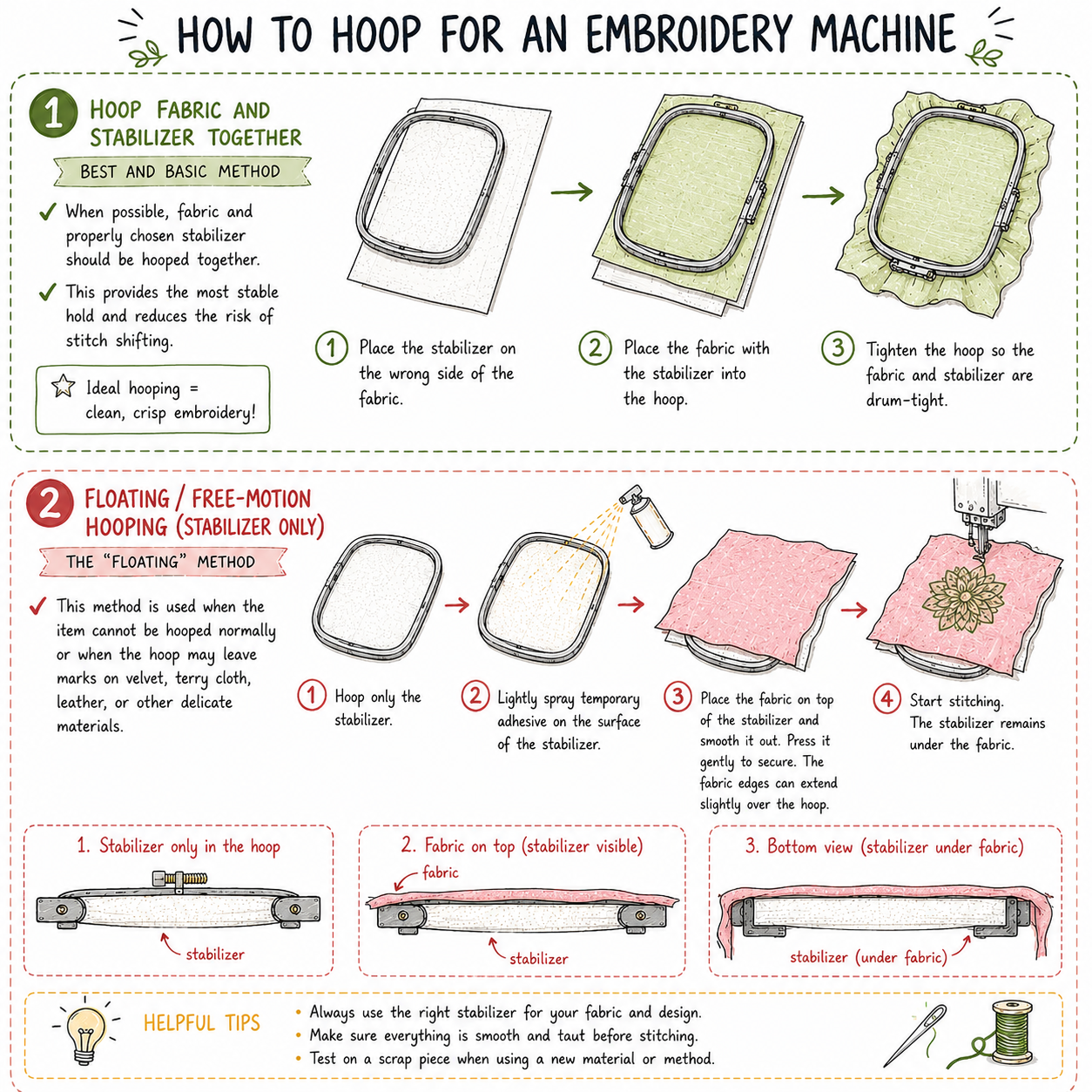
Real machine examples
Brother PE900 and SE2000
Brother markets both machines as having a 5×7 inch maximum embroidery area. In the same official product information, Brother specifies that designs can be created up to 130×180 mm.
This is the clearest example of why a design measuring 5.08×7.05 inches may still fit a machine described as 5×7. The exact 130×180 mm field—not the rounded product name—is the technical limit.
Janome RE20b
Janome lists the RE20b field as 140×200 mm and describes it as 5.5×7.9 inches. The exact mathematical conversion is approximately 5.51×7.87 inches, which Janome rounds for its English-language product description.
Janome SQ20b
The Janome SQ20b is listed as a 200×200 mm field and described as 7.9×7.9 inches. The exact conversion is approximately 7.87×7.87 inches.
These examples show that manufacturers do not all round measurements in the same direction. Sometimes the nominal inch number is slightly smaller than the precise conversion, and sometimes it is slightly larger.
Which measurement should Royal Present customers use?
On Royal Present product pages, the dimensions displayed for each size are the exact dimensions of the machine embroidery file. These values should be compared directly with the exact field supported by the embroidery machine.
For example:
- if the product page shows 128.7×178.9 mm (5.07×7.04 in);
- and the machine supports 130×180 mm (5.12×7.09 in);
- the design fits the machine’s nominal 5×7 hoop class.
The fact that the design converts to more than exactly 5.00 or 7.00 inches does not make it incompatible.
For help choosing the correct file extension, see our embroidery machine file formats guide.
Why a machine may not display a design
An incompatible embroidery field is one of the most common reasons a machine does not show a transferred design. However, also check:
- whether the downloaded ZIP folder has been extracted;
- whether the correct PES, JEF, DST, EXP, VP3 or other supported format was transferred;
- whether the file is stored in the correct folder on the USB drive;
- whether the filename contains unsupported characters;
- whether the selected hoop matches the file dimensions;
- whether the stitch count or number of colour changes exceeds the machine’s limit;
- whether the file was incorrectly resized or converted.
Read our detailed guide if your embroidery machine does not read a transferred design.
Should you resize a design that does not fit?
Do not automatically reduce a stitch file simply to make it fit a smaller field. An embroidery file contains stitch instructions rather than ordinary scalable artwork. Resizing without recalculating the stitches can damage:
- stitch density;
- underlay;
- pull compensation;
- satin-column width;
- fill spacing;
- small decorative details.
Embroidery Library also advises customers to choose one of the supplied sizes instead of resizing whenever possible. If a different size is required, use a professionally recalculated file.
Royal Present provides a machine embroidery design resizing service with stitch recalculation.
Choosing the smallest compatible hoop
Once you know that a design fits the machine’s embroidery field, select the smallest supported hoop that contains the entire design. A closer-fitting hoop generally provides better fabric control and reduces stabilizer waste.
A larger hoop may be appropriate when:
- several motifs are combined in one composition;
- the project requires a large placement area;
- the design is part of a long decorative border;
- the item cannot be repositioned conveniently.
The larger hoop must still be supported by the exact machine model. Buying a physically larger accessory does not automatically increase the embroidery unit’s maximum field.
Multi-position and endless hoops
A multi-position hoop allows different parts of a divided design to be stitched in separate attachment positions. It does not allow one oversized, undivided file to exceed the machine’s normal embroidery field.
An endless or border hoop is used to repeat connected motifs along table runners, towels, curtains, garments and other long projects. Each repeated section must still fit within the supported stitching field.
Learn more in our guide to endless hoops for Pfaff, Husqvarna Viking, Brother and other embroidery machines. You can use these techniques with designs from the Royal Present machine embroidery borders collection.
Checklist before purchasing a design
- Find the exact design dimensions on the product page.
- Check the exact embroidery field for your machine model.
- Do not rely only on the rounded 4×4, 5×7 or 6×10 label.
- Compare the measurements in millimetres whenever possible.
- Try rotating the design by 90 degrees if necessary.
- Confirm that the machine supports the supplied file format.
- Choose the smallest compatible hoop.
- Do not resize the file without stitch recalculation.
- Use the machine’s trace or boundary-check function before stitching.
You can test your machine, file-transfer process and hoop setup with our free machine embroidery designs.
Frequently asked questions about 5×7 and other hoop sizes
Is a 5×7 embroidery hoop exactly 5×7 inches?
Not always. On many Brother machines, the nominal 5×7 field is officially 130×180 mm, which converts to approximately 5.12×7.09 inches. The 5×7 name is rounded for convenience.
Will a 5.08×7.05 inch design fit a 5×7 hoop?
Yes, if the machine’s official field is 130×180 mm (5.12×7.09 in). A 5.08×7.05 inch design is approximately 129×179 mm, so it remains within that field.
Why does the product page show more than 5×7 inches?
The product page shows the exact conversion of the design dimensions. The 5×7 hoop name is rounded. Compare the exact design size with the exact metric field of the machine.
Is a 4×4 hoop exactly 4 inches square?
A common 4×4 field is 100×100 mm, which equals approximately 3.94×3.94 inches. In this case, the nominal inch name is slightly larger than the exact converted field.
Will a 98.5×98.5 mm design fit a 4×4 hoop?
Yes. A 98.5×98.5 mm design measures approximately 3.88×3.88 inches and fits within a 100×100 mm field.
Can a 130×180 mm design fit a 5×7 hoop?
It can fit if the exact machine model officially supports the full 130×180 mm field. Check the manual because not every hoop marketed as 5×7 has identical technical limits.
Are all 5×7 hoops compatible with all machines?
No. Hoop attachment systems, embroidery-unit travel, file limits and accessory compatibility vary by brand and model. A 5×7 Brother hoop cannot automatically be used on a Janome, BERNINA, Pfaff or Husqvarna Viking machine.
Should I measure my hoop with a ruler?
No. The outer frame and visible opening do not reliably show the machine’s usable embroidery field. Use the machine manual or official manufacturer specifications.
Does a larger physical hoop increase my machine’s field?
No. The embroidery unit determines the maximum movement of the needle. A larger frame can only be used within the capabilities supported by the machine and its software.
The most important rule
The rounded hoop name is a category. The metric embroidery field is the technical limit.
If your machine is advertised as 5×7 but its official embroidery field is 130×180 mm, a design measuring up to that field may fit even when its converted size appears slightly larger than exactly 5×7 inches.
Always compare:
exact design dimensions → exact machine embroidery field → supported file format
This prevents unnecessary resizing, incorrect compatibility conclusions and the common misunderstanding that a 5.08-inch design cannot fit a “5-inch” hoop.
Author: Ludmila Konovalova, Royal Present Embroidery
Originally published: March 25, 2023
Updated: July 20, 2026

Author: Ludmila Konovalova
My name is Ludmila Konovalova, and I lead Royal Present Embroidery. Embroidery for me is more than a profession; it is a legacy of my Ukrainian and Bulgarian heritage, where every woman in my family was a virtuoso in cross-stitch and smooth stitching. This art, passed down through generations, is part of my soul and a symbol of national pride.
Date: 20.07.2026

 Get Sign-In Link
 Login with Google
 Login with Facebook
 Login with Amazon
 Login with Paypal